
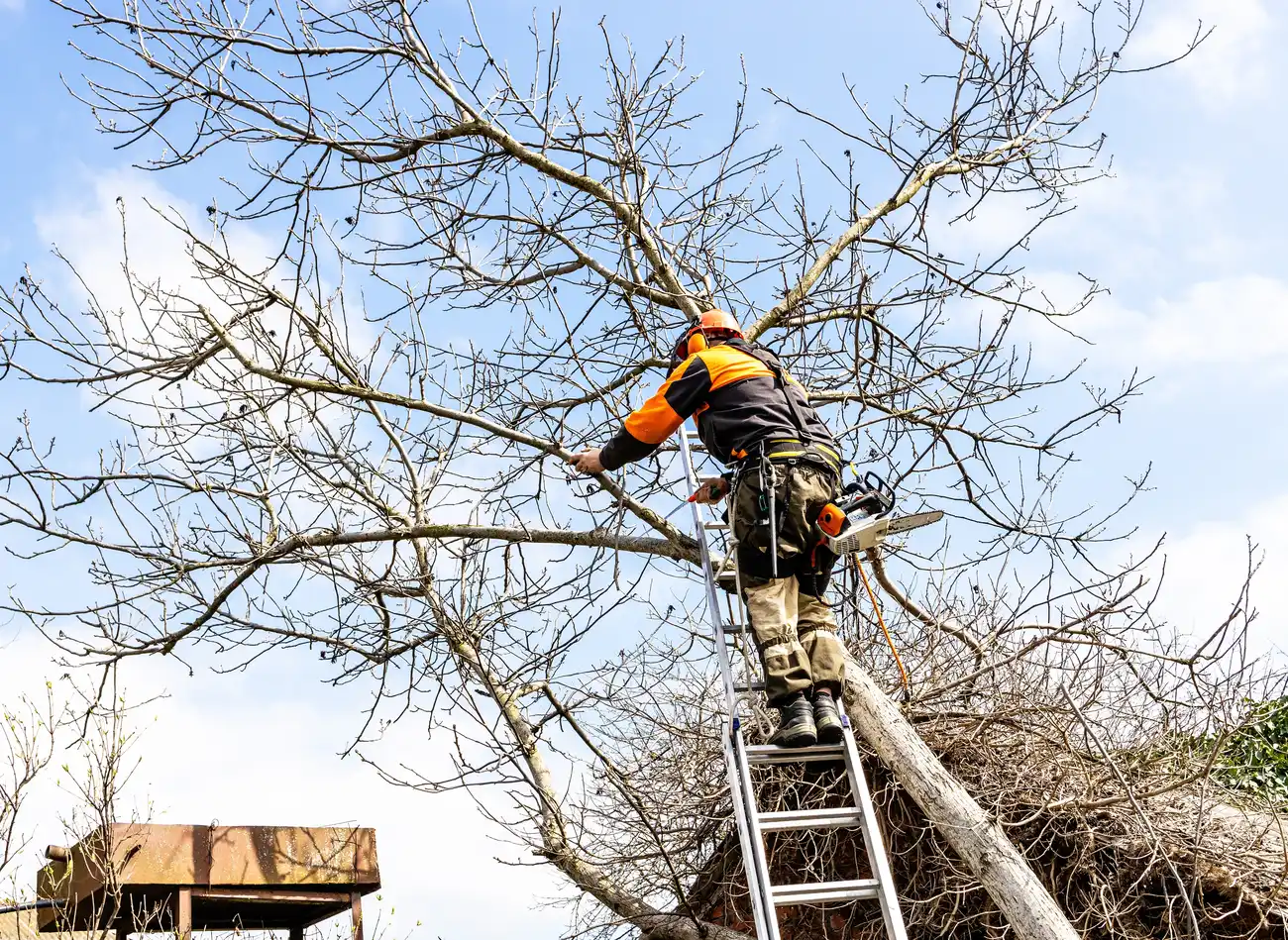
California tree service contractors face the most complex regulatory environment in the country. From the redwoods of the north to the palm-lined boulevards of Los Angeles to the wildfire-driven removal demand inland, California operates the largest tree service market in the United States — and the most demanding for insurance compliance. Working without proper licensing and insurance in California isn’t just risky — it’s grounds for fines up to $15,000 and possible jail time under Business and Professions Code §7028.
This page covers what California tree service insurance typically includes, how the new C-49 Tree and Palm Contractor License affects coverage, how California’s State Fund workers’ comp environment works for tree care operations, and what carriers are actively writing California tree service business.
What Tree Service Insurance Costs in California
California tree service insurance pricing reflects three state-specific realities: the C-49 licensing requirement (replacing the older C-61/D-49), California’s State Compensation Insurance Fund as a major workers’ comp carrier, and wildfire-driven risk pricing that affects most coverage lines.
The ranges below reflect what most California tree service contractors typically pay:
- General Liability Insurance: $1,400–$3,800 per year for typical California small operations. Bay Area and Los Angeles County operations sometimes pay toward the higher end given urban density and property values.
- Workers’ Compensation Insurance: $9–$18 per $100 of payroll for California tree service operations under class code 0106. A crew with $200,000 of payroll typically pays $18,000–$36,000 annually. California rates are among the highest in the nation due to industry claims experience.
- Commercial Auto Insurance: $2,200–$5,200 per truck per year for chip trucks, bucket trucks, and chipper-towing pickups in California. Pricing reflects high traffic density and severity of California auto claims.
- Inland Marine (Equipment) Insurance: $500–$1,800 per year depending on total equipment value. Bay Area and Los Angeles operations should pay particular attention to overnight storage and theft prevention.
- Pesticide & Pollution Liability: $500–$1,200 per year for California tree services performing plant health care work. CDPR documentation standards make this coverage particularly important.
- Umbrella / Excess Liability: $800–$1,800 per year for $1M of additional coverage above primary limits. Frequently required for municipal contracts, university work, and PG&E/SCE/SDG&E line clearance.
California’s combination of state-specific factors means tree service contractors who shop their coverage with an agent who actually understands California can often save 15–30% versus generic policies — particularly by qualifying for private workers’ comp markets versus default State Fund placement.
For a deeper breakdown of what drives these numbers — the WCIRB and State Fund comp posture, wildfire-hardened GL forms, Cal/OSHA documentation, and metro-by-metro variation — see our California tree service insurance cost guide. For the rating factors that apply in every state, including crew size, climbing versus bucket-truck access, fleet profile, and claims history, see the national cost guide.
Workers’ Compensation in California
California operates a unique workers’ compensation environment dominated by the California State Compensation Insurance Fund, which functions as the carrier of last resort and one of the largest writers of WC in the state. Private carriers also actively write California tree service business.
Class Code 0106 in California
Tree trimming and removal operations in California fall under NCCI class code 0106. California rates under 0106 are among the highest in the nation due to industry claims experience. The same misclassification issue we see across the country applies — operations placed under class code 0042 (landscape gardening) face back-premium audits when actual operations are discovered.
California-Specific Coverage Considerations
- WC required for C-49 licensure — California’s CSLB requires applicants to carry workers’ compensation insurance to qualify for the C-49 Tree and Palm Contractor License
- State Fund vs. private market — California operations defaulting to State Fund often pay 20–40% more than they would in the private market
- Sole proprietor exemptions — California allows sole proprietors to elect out, though coverage is recommended given physical risks and CSLB licensure considerations
- Subcontractor liability — uninsured subcontractors typically count as employees for premium calculation purposes
Specialty carriers focused on hazardous trades actively write California tree service business and often provide the best private-market pricing for safety-conscious operations.
California C-49 Licensing and Insurance Requirements
This is the section every California tree service owner needs to understand carefully — California’s C-49 Tree and Palm Contractor License creates the most complex contractor licensing environment for tree services in any state.
Background
As of January 1, 2024, California’s Contractors State License Board (CSLB) reclassified tree service contractors under the new C-49 Tree and Palm Contractor License, replacing the older C-61/D-49 classification. The C-49 is required for any tree work valued at $500 or more (labor plus materials) — making the licensing threshold lower than most other contractor types in California.
C-49 License Requirements
To qualify for a C-49 license, applicants must complete minimum 4 years of journey-level experience in tree service work, pass two state exams (the Law & Business exam and the C-49 Trade exam), obtain a contractor’s bond, complete fingerprinting and FBI background check, carry workers’ compensation insurance, pass an open-book asbestos test, and pay the initial license fee.
Commercial Timber Operations
For commercial timber operations — cutting trees for sale, barter, exchange, or trade — contractors also need a Licensed Timber Operator (LTO) credential issued by CAL FIRE. The “A” LTO requires loggers liability insurance and significant work experience. C-27 Landscaping Contractors can perform tree work only as part of a larger landscaping project, not as a standalone service.
What This Means for Tree Service Operations
- California tree service insurance is structurally tied to license status — lapses can affect CSLB standing
- Operations crossing state lines into Oregon or Nevada need policies that handle the transition correctly
- Choice of bond and surety relationships affects both pricing and renewal flexibility
- Working with an agent who understands C-49 specifically matters more here than in other states
Common Coverage Gaps in California Programs
- Chippers listed as trailers but never added to the schedule — a $60,000–$90,000 chipper is uninsured if it’s not explicitly listed
- Hired and non-owned auto — required if employees ever drive personal vehicles or rented trucks for company business
- Bucket trucks — confirm your policy covers the vehicle while the aerial function is in use, not just driving
- CSLB compliance documentation — many operations carry coverage that meets but doesn’t optimize for CSLB requirements
General Liability
General liability (GL) is the foundation of every California tree care insurance program. A properly structured GL policy covers bodily injury and property damage claims arising from your operations.
California tree service GL policies are typically written with occurrence-based coverage (preferred over claims-made for most contractors), completed operations coverage for claims that arise after a job is finished, and contractors’ professional liability if you provide arborist consulting or recommendations.
Municipal contracts in Los Angeles, San Francisco, San Diego, and Sacramento regularly require $1M–$2M per occurrence. UC system and California State University campus contracts typically require $2M per occurrence. PG&E, SCE, and SDG&E line clearance contracts often require $5M umbrella above primary GL.
Inland Marine / Equipment Floater
California crews typically carry $50,000–$250,000+ in portable equipment. Theft from job sites and unattended trailers is meaningful in Los Angeles, the Bay Area, and other urban concentrations. An equipment floater covers your chainsaws, climbing gear, rigging, stump grinders, and other portable equipment on the job site, in transit, and in storage.
Replacement cost coverage is strongly recommended over actual cash value — California’s high replacement costs and supply chain dynamics make this particularly important.
Pesticide & Pollution Liability
The California Department of Pesticide Regulation (CDPR) imposes some of the strictest pesticide handling requirements in the country. Tree services performing plant health care work in California need pesticide and pollution liability that meets CDPR documentation standards.
Standard GL policies will not respond to pollution claims arising from chemical applications. Contractor’s pollution liability (CPL) fills that gap and is increasingly required by commercial and municipal clients — especially in environmental-justice-designated areas where CDPR enforcement is most active.
Umbrella / Excess Liability
An umbrella policy adds limits above your GL, commercial auto, and employer’s liability limits. For California tree service companies working on municipal right-of-way, university campuses, or PG&E / SCE / SDG&E utility contracts, umbrella limits of $5M–$10M are frequently required.
A $1M umbrella typically costs a fraction of what your underlying GL costs — among the most efficient insurance purchases available, particularly given California’s strict liability environment in tree damage cases.
Los Angeles County: Where California’s Comp Cost Concentrates
California workers’ compensation is expensive statewide, but the burden is not spread evenly, and Los Angeles County sits at the heavy end. Operations quoting crews in the LA basin should understand which parts of that are structural and which parts they can influence.
The structural parts are the medical and indemnity cost of a claim in the region, the volume of represented claims, and a labor market where wage levels push the payroll base up before any rate is applied. None of those respond to shopping.
What does respond is everything the underwriter cannot see unless you show it:
- Function-level payroll splitting. A crew of six is not six identical exposures. Payroll assigned to climbers carries the aerial risk; ground personnel and yard staff do not. Operations that report a single undifferentiated payroll figure are quoted on the assumption least favorable to them.
- Written program, produced on request. Not a binder that exists — a program someone can hand over. Training records, tailgate meeting logs, and an aerial rescue plan crews have actually practiced.
- Geography stated honestly. LA County work priced as if it were Ventura County work does not survive an audit, and the correction arrives with the bill.
- Language of instruction matched to the crew. Safety training that crews cannot follow is not training, and carriers underwriting this region know it.
The palm work that characterises much of the LA market deserves separate mention. Palm trimming and removal carries its own well-documented hazard profile, and operations performing it should confirm it is explicitly contemplated in the operations description rather than assumed to ride along under general tree work.
Common Tree Service Risks in California
California’s geography, climate, and regulatory environment create distinctive risk patterns:
Wildfire Season Surge Demand
California’s wildfire seasons create surge demand for hazardous tree removal, dead/dying tree work, and defensible space clearing. Operations equipped for wildfire response capture significant revenue but face elevated risk during active fires. Tree work in high-fire-severity zones (HFSZ) requires specialized underwriting and often higher coverage limits.
Strict Liability Standards
California courts apply strict liability standards in many tree damage cases, making robust general liability coverage essential. A single property damage claim in coastal California, the Bay Area, or Los Angeles can easily exceed $500,000 — and properties valued in the millions create significant exposure on every job.
Palm Tree Specialization
Los Angeles, San Diego, and other Southern California markets feature substantial palm tree work — Canary Island date palms, Mexican fan palms, and Washingtonia robusta create specialized rigging and removal challenges. Insurance carriers familiar with palm work price this differently than standard hardwood operations.
Aging Urban Canopy
San Francisco’s mature street trees, Pasadena’s heritage neighborhoods, and Sacramento’s historic districts have substantial mature tree populations. Tree work near historic properties raises liability exposure and often triggers additional permitting requirements.
Utility Line Clearance Demand
PG&E, Southern California Edison, San Diego Gas & Electric, and Los Angeles Department of Water and Power run substantial vegetation management programs across California — particularly in wildfire-prone areas. Operations doing line clearance work need higher liability limits, ANSI Z133 compliance, and specialized underwriting.
Coastal and Drought Stress
California’s coastal climate and recurring drought stress create distinctive tree health challenges. Plant health care work involving drought-stressed trees, sudden oak death, and bark beetle infestations creates specific environmental and pesticide exposure that affects insurance pricing.
Why California Tree Service Owners Choose TreeGuard
We understand California C-49 licensing. Most insurance agents treat California contractor coverage like any other state — they shouldn’t. We help California tree service operations understand C-49 requirements, CSLB documentation, and how to structure coverage correctly around licensing.
We know the State Fund versus private market dynamic. California operations defaulting to State Fund often pay significantly more than they would in the private market. We help operations evaluate which path makes sense for their specific operation.
As an independent agency, we represent 16+ A-rated carriers and shop your operation across the entire market. You’re not stuck with one company’s underwriting appetite or pricing — we find the carrier that best fits your specific California operation.
We specialize in tree care. We don’t write the occasional tree service policy as a side line — this niche is our focus.
Quote turnaround is fast. Most California tree service quotes come back within 1–2 hours during business hours.
Major California Markets We Serve
We write tree service insurance across all of California, with strong concentration in:
- Los Angeles County: Los Angeles, Long Beach, Santa Monica, Pasadena, Glendale, Burbank, Beverly Hills — high-density urban tree work, palm specialization, premium residential markets.
- San Francisco Bay Area: San Francisco, Oakland, San Jose, Berkeley, Palo Alto, Walnut Creek — premium residential and commercial markets, mature urban canopy.
- San Diego County: San Diego, La Jolla, Carlsbad, Encinitas — coastal markets with hurricane-strength wind exposure.
- Sacramento Valley: Sacramento, Roseville, Folsom — agricultural tree work, state capital institutional market, storm-driven demand.
- Central Coast: Santa Barbara, San Luis Obispo, Monterey — wine country tree care, premium estate properties.
- Inland Empire: Riverside, San Bernardino, Ontario — growing residential and commercial markets.
- Central Valley: Fresno, Bakersfield, Modesto, Stockton — agricultural and mixed urban/rural tree work.
- Wildfire Corridors: defensible space and hazard removal across El Dorado, Placer, Napa, Sonoma, and high-fire-severity counties statewide.
Whether you’re a single-truck operation in San Diego or a 40-employee crew working across Los Angeles County, we can write your business in California.