
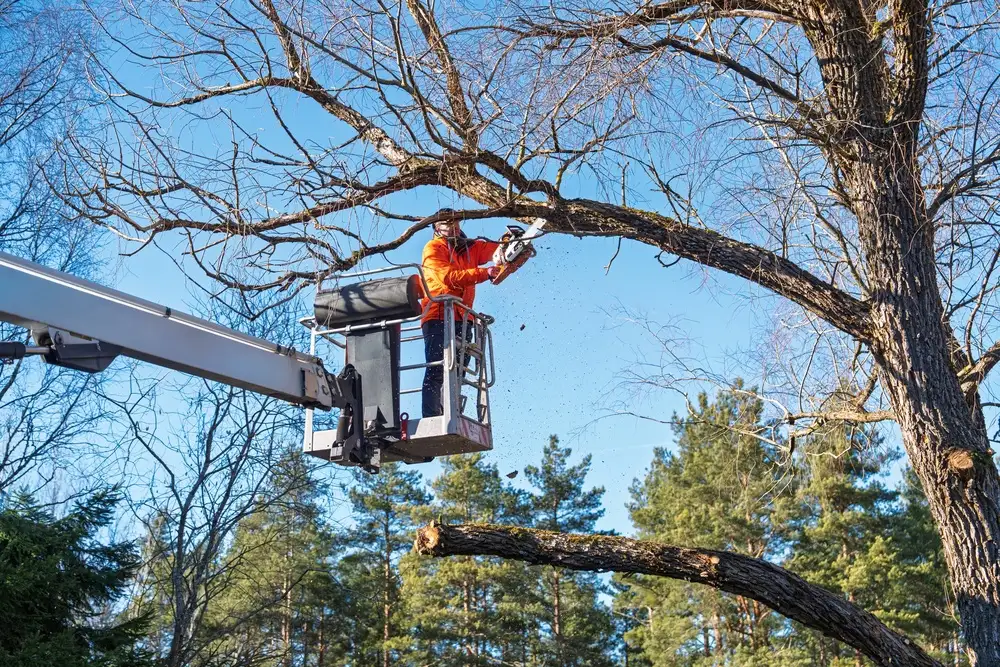
California tree service insurance typically costs $9,000 to $32,000+ per year for a small-to-mid-size operation. A single-crew operation with $200,000 in payroll usually pays $14,000–$24,000 annually — making California consistently the most expensive U.S. state for tree service insurance. Workers’ compensation alone runs 25–40% above the national average, and operations performing wildfire mitigation work or operating in High Fire Hazard Severity Zones often pay an additional 10–20% premium loading.
At TreeGuard Insurance, where we write California tree service operations across our 16+ carrier panel, we see three structural cost drivers that don’t exist in most other states: California’s own workers’ comp rating bureau (WCIRB) with its monopolistic State Compensation Insurance Fund alternative, post-2017 wildfire-hardened markets, and the layered regulatory stack of CSLB contractor licensing, CDFA pesticide tiers, and Cal/OSHA compliance documentation. Most cost articles quote generic ranges as if California works like Texas or Florida. It doesn’t.
This guide breaks down what California tree service contractors actually pay in 2026, the structural decisions that drive cost, and the metro-by-metro variation we see when shopping coverage. If you want a fast answer on your specific operation, get a California quote here.
Looking for national pricing rather than California? This page covers what is different about California specifically. If you want the general rating factors that apply in every state — crew size, climbing versus bucket-truck access, fleet and equipment profile, state comp posture, and claims history — start with our main guide to tree service insurance cost. Come back here for the California layer on top.
The California-Specific Cost Drivers Other Guides Miss
The first major California-specific driver is the workers’ compensation market structure. California operates its own rating bureau — the Workers’ Compensation Insurance Rating Bureau (WCIRB) — rather than using NCCI. California also operates the State Compensation Insurance Fund (SCIF), a quasi-state insurer that functions as a market of last resort. SCIF will write operations that no private carrier will touch — but at pricing 30–60% above competitive private market rates. Operations stuck on SCIF are usually there because their claims profile, operational structure, or contractor licensing status makes them unattractive to the private competitive market.
In our experience, the difference between SCIF and a properly placed specialty private carrier for a $200,000 payroll California 0106 operation is typically $9,000–$15,000 per year — enough to fund an entirely separate insurance line. The path off SCIF requires cleaning up the underwriting submission, addressing whatever historical issue caused the SCIF placement, and routing the submission to private markets that actively write California 0106 (a smaller universe than in most states).
The second major California-specific driver is wildfire liability exposure. The 2017 (Tubbs, Atlas, Nuns), 2018 (Camp Fire, Carr Fire, Mendocino Complex), 2020 (August Complex, North Complex, Glass Fire), and 2025 fire seasons have permanently reshaped the California commercial property and casualty market. Carriers writing California tree service have substantially tightened wildfire-related coverage in standard GL forms. Operations doing CAL FIRE defensible-space work, fuel reduction, or operating in High Fire Hazard Severity Zones often discover at claim time that their GL form has wildfire-ignition limitations they didn’t recognize at bind.
The third driver is the layered California regulatory stack. The Contractors State License Board (CSLB) requires a C-49 Tree and Palm Contractor License for tree care work valued at $500 or more — a classification that took effect January 1, 2024 and replaced the older C-61/D-49 Tree Service limited specialty. Operations still describing themselves by the retired code on submissions and certificates create avoidable friction with underwriters. The CDFA Pesticide Regulation Division licenses applicators across multiple categories. Cal/OSHA has California-specific tree care standards that exceed federal OSHA in several areas. Each layer creates underwriting friction that less-California-experienced carriers handle poorly.
The Cal/OSHA Layer California Operators Underestimate
California is a state-plan state: workplace safety is regulated by the California Division of Occupational Safety and Health under Title 8 of the California Code of Regulations, not by federal OSHA. Title 8 is more prescriptive than the federal standard in several areas that bear directly on tree work, and underwriters writing California operations read compliance documentation as a proxy for how the operation is actually run.
Three Title 8 requirements matter most for tree service operations:
The Injury and Illness Prevention Program. California requires every employer to establish and maintain a written IIPP — this is a California-specific obligation with no direct federal counterpart, and it applies regardless of headcount. A compliant program identifies who is responsible, how hazards are identified and corrected, how the program is communicated to employees, and how training is documented. Cal/OSHA citations for a missing or paper-only IIPP are common, and an operation that cannot produce one on request presents poorly both to the regulator and to an underwriter reviewing the account.
Heat illness prevention. California maintains a heat illness prevention standard for outdoor places of employment covering access to shade, drinking water, rest, acclimatization for new crew members, emergency response procedures, and additional high-heat procedures once temperatures cross a defined threshold. Tree work in the Central Valley and inland Southern California sits squarely inside the conditions the standard was written for. Documented compliance — written procedures, training records, actual shade and water on the truck — is both a regulatory necessity and an underwriting signal.
Tree work and electrical safety orders. Title 8 contains specific safety orders for tree work, maintenance, and removal, alongside the electrical safety orders that govern minimum approach distances to energized conductors. Line clearance work has its own qualification requirements. Operations that perform any work near utility lines should be able to demonstrate who on the crew is qualified and what clearances they observe.
Layered on top of Title 8, the industry consensus standard for arboricultural operations — ANSI Z133 — is what carriers and plaintiff experts alike reference when evaluating whether a job was performed to accepted practice. Cal/OSHA compliance and Z133 conformance are related but not identical, and a program built to satisfy only one of them leaves a gap.
Why this shows up in your premium: none of these requirements is priced as a separate line item. They surface in underwriting as the difference between an operation that can produce a written program, training records, and inspection logs on request, and one that cannot. In a state where the carrier universe writing tree service is smaller than average, that documentation is often what determines whether an operation gets a competitive private-market quote at all. The authoritative source for the standards themselves is the California Division of Occupational Safety and Health.
Real Cost Ranges We See in California
Here’s what TreeGuard typically quotes for California tree service operations across our carrier panel:
| Operation Size | Private Market Total | SCIF / Surplus Lines Total |
|---|---|---|
| Solo operator (no employees) | $5,200–$8,200/yr | $7,500–$12,000/yr |
| Single crew ($150K–$250K payroll) | $14,000–$24,000/yr | $22,000–$35,000/yr |
| Two-crew operation ($600K–$1M revenue) | $26,000–$48,000/yr | $40,000–$70,000/yr |
| Multi-crew ($1M+ revenue) | $42,000–$95,000+/yr | $65,000–$140,000+/yr |
These figures reflect total spend across general liability, workers’ compensation, commercial auto, inland marine, and umbrella. They do not include surety bonds (the CSLB requires a $25,000 contractor bond) or pesticide & pollution liability for operations performing chemical work.
A few things to note from what we actually see in submissions:
- Bay Area operations typically pay 15–25% above the California average — property values, urban density, and labor cost loadings all factor in.
- North Coast operations (Sonoma, Napa, Mendocino, Humboldt) face wildfire-driven pricing 15–30% above state average on inland marine and any property-related coverage.
- Operations doing CAL FIRE defensible-space contracts add $1,200–$3,500 annually for either an endorsement or a standalone wildfire-liability policy.
Cost by Coverage Type in California
General Liability
General liability for a typical California single-crew operation runs $1,800–$3,400 per year. California-specific underwriting note: confirm the GL form’s wildfire-ignition treatment in writing before bind. Carriers vary substantially on whether and how wildfire damage from escaped operations is covered. Operations in High Fire Hazard Severity Zones often need a specific endorsement.
Workers’ Compensation
California WC for 0106 runs $9–$18 per $100 of payroll in the private competitive market and $14–$26+ per $100 on SCIF. A $200,000 payroll crew typically pays $18,000–$36,000 in private market WC. California-specific underwriting note: California uses experience modifier calculations that differ from NCCI’s standard formulas — the ex-mod is calculated by WCIRB on a slightly different basis. An operation moving from another state to California typically sees its mod recalculated, sometimes upward.
Commercial Auto
California commercial auto runs $2,200–$4,500 per truck per year — among the most expensive in the country. California-specific underwriting note: California requires uninsured/underinsured motorist coverage at specific limits, and the state’s commercial auto market has been hardening for the past three years due to litigation cost loading. MVR violations are particularly punitive in California — a single citation can move a quote by 15–25%.
Inland Marine / Equipment
Inland marine runs $500–$1,800 per year for typical California equipment schedules. California-specific underwriting note: equipment stored in High Fire Hazard Severity Zones faces wildfire-related underwriting questions and sometimes exclusions or higher named-storm-style deductibles. Confirm wildfire is not excluded by endorsement.
Pesticide & Pollution Liability
CPL for California tree services performing chemical work runs $500–$1,200 per year. California-specific underwriting note: the CDFA Pesticide Regulation Division operates a tiered licensing structure (Qualified Applicator License vs. Pest Control Business License), and carriers verify the correct license tier matches the operations description. Operations performing oak treatment work in coastal counties also navigate Sudden Oak Death (Phytophthora ramorum) quarantine restrictions affecting transport of host material.
Umbrella / Excess
Umbrella limits of $1M cost $700–$1,800 per year in California — higher than most states because of the underlying GL and auto cost loading. California-specific underwriting note: PG&E and Southern California Edison vegetation management contracts typically require $5M–$10M umbrella, and post-2017 wildfire litigation has made California umbrella markets more selective about utility line clearance operations.
Cost by Major California Metro
California is large enough that metro-level pricing variation is substantial. Here’s what we typically see:
San Francisco Bay Area: 15–25% above California state average. Property values, labor cost loadings, urban density, and litigation cost factor in. Operations doing work in Marin, San Mateo, and Santa Clara county high-value residential areas often need elevated GL limits.
Los Angeles Metro: 10–20% above state average. Dense urban canopy in Hancock Park, Beverly Hills, Brentwood, and Pasadena raises liability exposure. LA County jury environment has been increasingly plaintiff-favorable.
Orange County / San Diego: 5–15% above state average. High-value coastal properties drive umbrella requirements upward.
Sacramento / Central Valley: Closest to California state average. Lower wildfire exposure than North Coast, lower property values than coastal markets.
North Coast (Sonoma, Napa, Mendocino, Humboldt, Lake counties): 15–30% above state average on inland marine and wildfire-related coverage. The 2017 and 2020 fire seasons fundamentally reshaped underwriting for these counties.
Sierra Foothills and Mountain communities: Substantial wildfire exposure produces 20–35% above state average on most lines for operations based or working in High Fire Hazard Severity Zones. CAL FIRE defensible-space contractors have additional underwriting requirements.
Inland Empire (Riverside, San Bernardino): Closer to state average on most lines. Lower property values reduce GL requirements; commercial auto runs comparable to LA.
The Most Common Coverage Gap We See in California
In our experience writing California tree service operations, the single most common coverage gap is wildfire-ignition liability not being clearly addressed in the GL form.
Operations doing fuel reduction, defensible-space work, hazard-tree removal in fire-prone areas, or any operations involving chainsaw or chipper work during red flag warning periods face real wildfire ignition exposure. A standard GL form may include or exclude or sub-limit damage arising from a fire that escapes the operation’s control — and the difference between these treatments only becomes visible at claim time.
We routinely see California operations with $1M GL policies that they believe cover wildfire exposure but that contain narrow endorsements limiting coverage to direct first-party property damage or excluding red flag warning period work entirely. The fix is either:
- A specific wildfire-liability endorsement on the GL form, with clear coverage language and adequate limits, or
- A standalone wildfire/CPL-style policy structured for the work.
The second-most-common gap is operations on SCIF for reasons that no longer apply — historical claims that have rolled off the ex-mod calculation, contractor license issues that have been resolved, or operational structure issues that have been corrected. Re-shopping the WC submission once underlying issues are resolved produces real annual savings.
How to Lower Your California Tree Service Insurance Costs
1. Get off SCIF if you can. If you’re on SCIF because of a historical issue that no longer applies, a clean submission to the private competitive market typically saves $9,000–$15,000 per year on a $200K payroll operation. The submission needs to be properly framed.
2. Document CAL FIRE-compliant work. Operations doing defensible-space and fuel reduction work that maintain documented CAL FIRE Defensible Space Inspector compliance, ANSI Z133 documentation, and red-flag-day work suspension protocols are attractive to the smaller universe of carriers writing California wildfire-exposed tree service.
3. Confirm CSLB license status. Carriers verify CSLB license at bind and during the policy term. A lapsed C-49 license can trigger non-renewal and creates significant liability exposure. If your records still carry the retired C-61/D-49 classification, reconcile them before renewal.
4. Manage your WCIRB ex-mod. The California ex-mod uses slightly different formulas than NCCI. Operations should review their WCIRB experience modification worksheet annually for errors — we routinely find mod calculation errors that, once corrected, save 5–15% on WC premium.
5. Document Cal/OSHA safety program compliance. California has specific tree care standards that go beyond federal OSHA. Operations with documented Cal/OSHA Tree Work Safety Orders compliance signal training to underwriters.
6. Schedule equipment at replacement cost — and disclose where it sleeps. Inland marine floaters written at actual cash value pay 30–60% less than replacement cost on three-to-five-year-old equipment. In California the valuation question is compounded by storage location: equipment yarded inside a High Fire Hazard Severity Zone draws wildfire-related underwriting questions, and sometimes exclusions, that the same schedule would not draw in a coastal metro.
7. Restructure before chasing PG&E or SCE vegetation management work. Utility line clearance contracts require $5M+ umbrella supported by acceptable primary GL and auto, and a clean wildfire underwriting story. Restructure 60+ days before signing.
8. Get ISA certified. ISA certification and TCIA accreditation produce preferred-rate access at several California specialty carriers — and they carry extra weight here, because the universe of carriers writing California tree service is smaller than in most states.
The levers above are the ones specific to California. The general ones that apply in every state — controlling your experience modifier, splitting payroll accurately between aerial and ground work, tightening driver standards, and reconciling the equipment schedule annually — are covered in our national cost guide.
When You Should Get California Quotes Restructured
A new quote-and-restructure cycle makes sense when:
- You’re currently on SCIF and the underlying issue has been resolved
- Revenue grows 25%+ year-over-year — your GL rating base shifts and many carriers re-tier
- You add a new service line — particularly when adding wildfire mitigation, plant health care, or utility line clearance
- You experience a wildfire-related claim — restructuring the GL wildfire language before renewal often produces better outcomes
- You’re chasing PG&E, SCE, or SDG&E vegetation management — those contracts require $5M+ umbrella with specific primary structure
- Your WCIRB ex-mod moves meaningfully — a mod moving from 1.20 to 0.95 is worth re-shopping
When any of these trigger, request a California quote and we’ll shop the entire panel.
Frequently Asked Questions
How much does tree service insurance cost in California?
A single-crew California tree service with $200,000 in payroll typically pays $14,000–$24,000 annually across general liability, workers’ compensation, commercial auto, and equipment coverage. California is consistently the most expensive U.S. state for tree service insurance.
Why is California tree service insurance so expensive?
Three structural reasons: California uses its own WCIRB rating bureau (rather than NCCI) with higher base rates, wildfire liability exposure has hardened the California commercial casualty market since 2017, and the layered CSLB / CDFA / Cal/OSHA regulatory stack creates underwriting complexity that less-California-experienced carriers handle poorly.
What workers’ comp class code applies to California tree service?
California tree service operations are typically classified under WCIRB class code 0106 — California’s equivalent to the NCCI 0106 used in most other states. California operates a unique competitive WC market alongside the State Compensation Insurance Fund (SCIF), a quasi-state insurer of last resort.
Do California tree service operations need a contractor’s license?
Yes. California requires a CSLB license for any tree care work valued at $500 or more. As of January 1, 2024 the relevant classification is C-49 (Tree and Palm Contractor), which replaced the older C-61/D-49 Tree Service limited specialty. C-27 (Landscaping) contractors can perform tree work only as part of a larger landscaping project, not as a standalone service. Operating without proper CSLB licensing creates significant liability exposure and is a frequent point of dispute in litigation. See our California state guide for the full licensing breakdown.
Does California require special insurance for wildfire mitigation work?
California does not statutorily mandate wildfire-specific insurance for tree service operations, but carriers underwriting California tree service have substantially tightened wildfire-related coverage in standard GL forms since 2017. Operations doing CAL FIRE-compliant fuel reduction or operating in High Fire Hazard Severity Zones often need a specific wildfire-liability endorsement or a standalone policy.
How do costs vary across major California metros?
Bay Area operations (San Francisco, Oakland, San Jose) pay 15–25% above the California state average across most lines due to property values, wage levels, and dense urban canopy. Los Angeles metro runs 10–20% above state average. Sacramento and Central Valley operations run closer to state average. North Coast operations (Sonoma, Napa, Mendocino) face significant wildfire-related pricing variance — typically 15–30% above state average on inland marine and any wildfire-mitigation-related coverage.
What Cal/OSHA requirements affect California tree service insurance?
California is a state-plan state, so workplace safety is governed by Title 8 of the California Code of Regulations rather than federal OSHA. Three requirements matter most for tree work: a written Injury and Illness Prevention Program, which California requires of every employer and which has no direct federal counterpart; the heat illness prevention standard for outdoor work, covering shade, water, rest, acclimatization, and high-heat procedures; and the specific tree work and electrical safety orders governing minimum approach distances to energized conductors. None of these is priced as a separate line item, but underwriters read the documentation as evidence of how the operation is actually run.
How fast can TreeGuard quote California tree service insurance?
Most California tree service quotes come back within 1–2 business hours during business hours. Call 317-942-0549 or submit our online quote form.
What’s the most common California tree service insurance coverage gap?
The single most common coverage gap is wildfire-ignition liability not being clearly addressed in the GL form. Many standard GL policies sub-limit or exclude damage arising from fire that escapes the operation’s control. Operations doing CAL FIRE defensible-space contracts often discover after a claim that their GL form has limitations they didn’t recognize at bind.
The Bottom Line on California Tree Service Insurance Cost
California is the most expensive state in the country for tree service insurance, and the structural reasons are durable: WCIRB rate structure, post-2017 wildfire-hardened markets, and the layered CSLB/CDFA/Cal-OSHA regulatory stack. The path to optimizing cost runs through proper carrier selection (getting off SCIF when possible), proper wildfire-liability structure on the GL form, and proper Cal/OSHA and CAL FIRE compliance documentation.
For deeper context on tree service insurance generally, see our main cost guide. For other state-specific cost analyses, see our guides for Texas, Florida, New York, and Ohio. Ready to see what your California operation should actually pay? Start your California quote here.
External authoritative resources: California Department of Insurance, California Division of Workers’ Compensation, BLS occupational fatality data, and International Society of Arboriculture.
About the Author
Nate Jones is the founder of Wexford Insurance and TreeGuard, a specialty insurance agency writing tree service operations in 48 states across a 16+ A-rated carrier panel. He works directly with California tree service contractors daily and has extensive experience structuring wildfire-exposed and CAL FIRE defensible-space programs. Connect via the TreeGuard quote form or call 317-942-0549.

More from Coverage Explained
Ready to get properly covered?
Tell us about your tree care operation and we'll compare options across our carrier network. Quote response within 1–2 hours during business hours.
Independent agency · 16+ A-rated carriers · Licensed in 48 states