
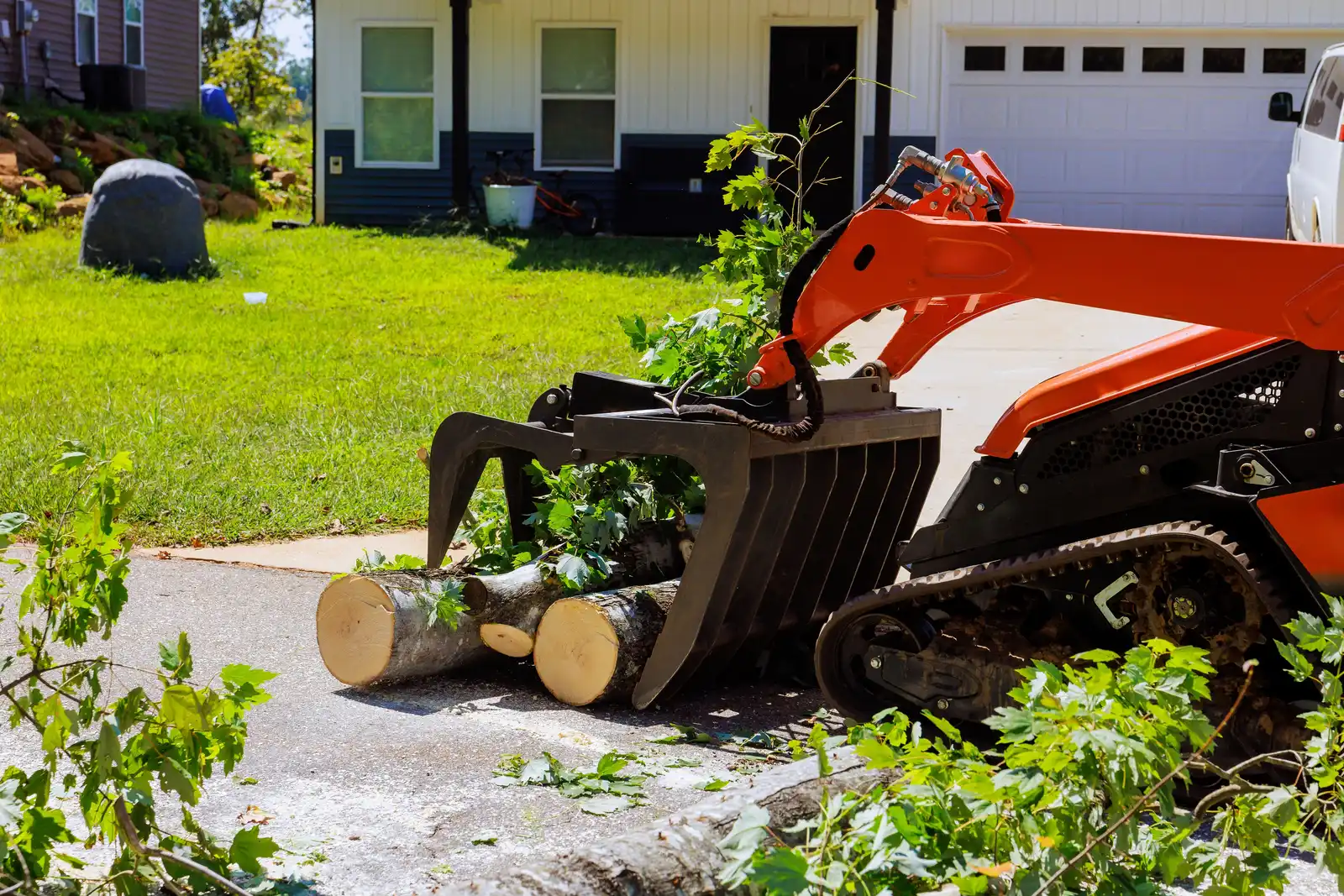
Stump grinding occupies a unique position in the tree care industry. Many contractors run stump-grinding-only operations — single-truck mobile businesses that subcontract from full-service tree companies. Other contractors do stump grinding as a service line within a broader operation. Both models have specific insurance considerations that differ from general tree care underwriting.
The risk profile is also distinctive. Stump grinding doesn’t involve climbing or aerial work — eliminating the highest-severity tree care claims. But stump grinding generates one signature claim category that no other tree work generates with the same frequency: flying debris. A stump grinder can throw rocks, debris, or wood fragments substantial distances at high velocity. The most-cited claim scenario across the industry: a stump grinder throws a rock that breaks a window, damages a vehicle, or — in worst cases — strikes a person or vehicle in traffic.
This page covers what stump grinding insurance includes, what it costs, the licensing requirements that vary by state, and what carriers actively write stump-grinding operations.
What Stump Grinding Insurance Costs
Stump grinding operations typically need a slightly different coverage program than full tree service operations:
- General Liability Insurance: $850–$2,500 per year for $1M per occurrence / $2M aggregate. The flying-debris exposure is the primary GL concern. Most insurers recommend a minimum $1M policy for stump grinding even for solo operators.
- Workers’ Compensation Insurance: $4–$10 per $100 of payroll. Stump grinding can sometimes qualify for class code 0042 (Landscape Gardening) instead of 0106 if no aerial or climbing work is performed — significantly cheaper. Some states classify stump grinding under 0106 regardless. The classification depends on state rules and how the operation is structured.
- Commercial Auto Insurance: $1,500–$2,800 per truck per year, plus trailer coverage if you tow your grinder.
- Inland Marine (Equipment) Insurance: $400–$1,500 per year. This is critical for stump grinding operations. Professional stump grinders cost $15,000–$50,000+, and a self-propelled tracked grinder can run $35,000–$80,000. Equipment loss without coverage is a business-ending event for most stump grinding operations.
- Umbrella / Excess Liability: $400–$1,000 per year for $1M of additional coverage. Recommended even for solo operators because of the flying-debris severity exposure.
For most stump-grinding-only operations, total program cost runs $4,000–$10,000 annually for solo operators, $10,000–$25,000 for small crew operations.
State Licensing for Stump Grinding
Stump grinding licensing requirements vary substantially by state. Some states impose specific licensing requirements that don’t apply to general tree care:
Oregon: Stump grinding requires either a Landscape Contractors Board (LCB) license or a Construction Contractors Board (CCB) license. Both have specific liability insurance minimums and bonding requirements.
California: Operations performing contracts valued at $500 or more typically require a C-49 Tree and Palm Contractor License through the Contractors State License Board, the classification that replaced the older C-61/D-49 Tree Service limited specialty on January 1, 2024.
Florida: Stump grinding doesn’t require a state contractor license, but counties and municipalities frequently require local business licenses.
Texas: No state license required, but commercial pesticide work (stump treatment) requires Texas Department of Agriculture licensing.
Virginia: Stump grinding contracts above $1,000 trigger DPOR contractor licensing requirements — pure tree trimming may be exempt, but stump grinding (below-grade, land-disturbing work) typically requires DPOR licensure.
Most Other States: No state-level licensing for stump grinding specifically, but local business licensing and pesticide applicator licensing (if applicable) are common.
We help our clients understand which licensing applies to their specific operation and ensure their insurance program meets licensing requirements.
What Makes Stump Grinding Insurance Different
A stump-grinding-focused operation faces a different risk profile than full tree service:
1. The Flying-Debris Claim Category
Stump grinders throw rocks, dirt, wood debris, and root fragments at high velocity. The most-cited scenarios across the industry: a rock thrown by the grinder breaks a window in a nearby house, damages a parked vehicle, or — in worst-case scenarios — flies into traffic and damages or injures a passing motorist. This last scenario is the reason most insurers recommend $1M minimum GL even for solo operators.
2. Underground Utility Strikes
Grinding below grade exposes operations to underground utility strikes — water lines, gas lines, electrical, fiber, irrigation. Operations doing residential stump grinding often grind without underground utility location (Call Before You Dig / 811), creating substantial exposure. Some carriers explicitly exclude underground utility damage unless an XCU (Explosion/Collapse/Underground) endorsement is added.
3. Property Damage to Lawns, Hardscapes, and Irrigation
Stump grinders are heavy machines (often 6,000+ lbs for self-propelled units) that can damage lawns, irrigation systems, sprinkler heads, and hardscape during operation. Property damage from equipment movement is one of the most frequent stump grinding claims.
4. Equipment Value Concentration
A typical stump grinding operation has a disproportionate share of total business value tied up in one or two grinders. A stolen or destroyed Vermeer SC60TX or Bandit SG-75 represents 30–60% of typical operation business value. Equipment coverage with appropriate replacement-cost basis is essential.
5. Subcontractor Relationships
Many stump grinding operations work as subcontractors to larger tree service companies. The subcontractor relationship has specific insurance implications: the prime contractor typically requires the subcontractor to carry $1M GL, name the prime as additional insured on a primary/non-contributory basis, and provide a waiver of subrogation. These requirements are non-negotiable for most prime contractor relationships.
Common Stump Grinding Claims We See
Flying Debris Window and Vehicle Damage
The signature stump grinding claim. Average claim severity: $300–$3,000 for residential windows and minor vehicle damage, $5,000–$25,000 for vehicle windshield damage on moving vehicles, six figures for incidents that cause traffic accidents.
Underground Utility Strike
The grinder hits an underground utility — water line, gas line, electrical, fiber, irrigation. Average claim severity: $500–$2,000 for irrigation, $1,500–$8,000 for water lines, $5,000–$50,000+ for gas or electrical strikes (which can also trigger evacuation events). Many policies require the XCU endorsement to cover underground exposures.
Lawn and Hardscape Damage
The grinder’s tracks or wheels damage lawn, irrigation, decorative concrete, pavers, or other hardscape during equipment movement. Average claim severity: $300–$5,000.
Equipment Theft or Vandalism
A $35,000 stump grinder is stolen from a job site, parked trailer, or contractor yard. Average claim severity: $15,000–$80,000. Recovery rates for stolen tree care equipment are lower than for general construction equipment because grinders are often parted out.
Operator Injury from Debris
The operator is struck by debris thrown by their own grinder, or by debris from a coworker’s grinder. Workers’ comp claim, often involving eye injury, lacerations, or impact trauma. Drives up EMR for three years.
Why Stump Grinding Operations Choose TreeGuard
We understand the flying-debris exposure. We don’t underprice stump grinding GL just to get the policy, then leave clients exposed at claim time. Our recommendations reflect the actual risk profile.
We help with class code optimization. Stump grinding can sometimes qualify for class code 0042 instead of 0106, depending on state rules and operational structure. We help our clients explore whether the lower-rated classification applies — saving substantial premium for solo operators and small crews.
We work with the right carriers. Some standard carriers won’t write stump-grinding-only operations because they don’t fit standard tree service templates. We have access to specialty markets that specifically write stump grinding.
We help with subcontractor compliance. If you subcontract for tree service companies, your insurance certificate has to meet their specific requirements (additional insured, primary/non-contributory, waiver of subrogation, XCU endorsement). We make sure your COI matches what your prime contractors require.
We specialize in tree care. This includes specialty operations like stump grinding — not just full-service tree care.
Quote turnaround is fast. Most stump grinding quotes come back within 1–2 hours during business hours.