
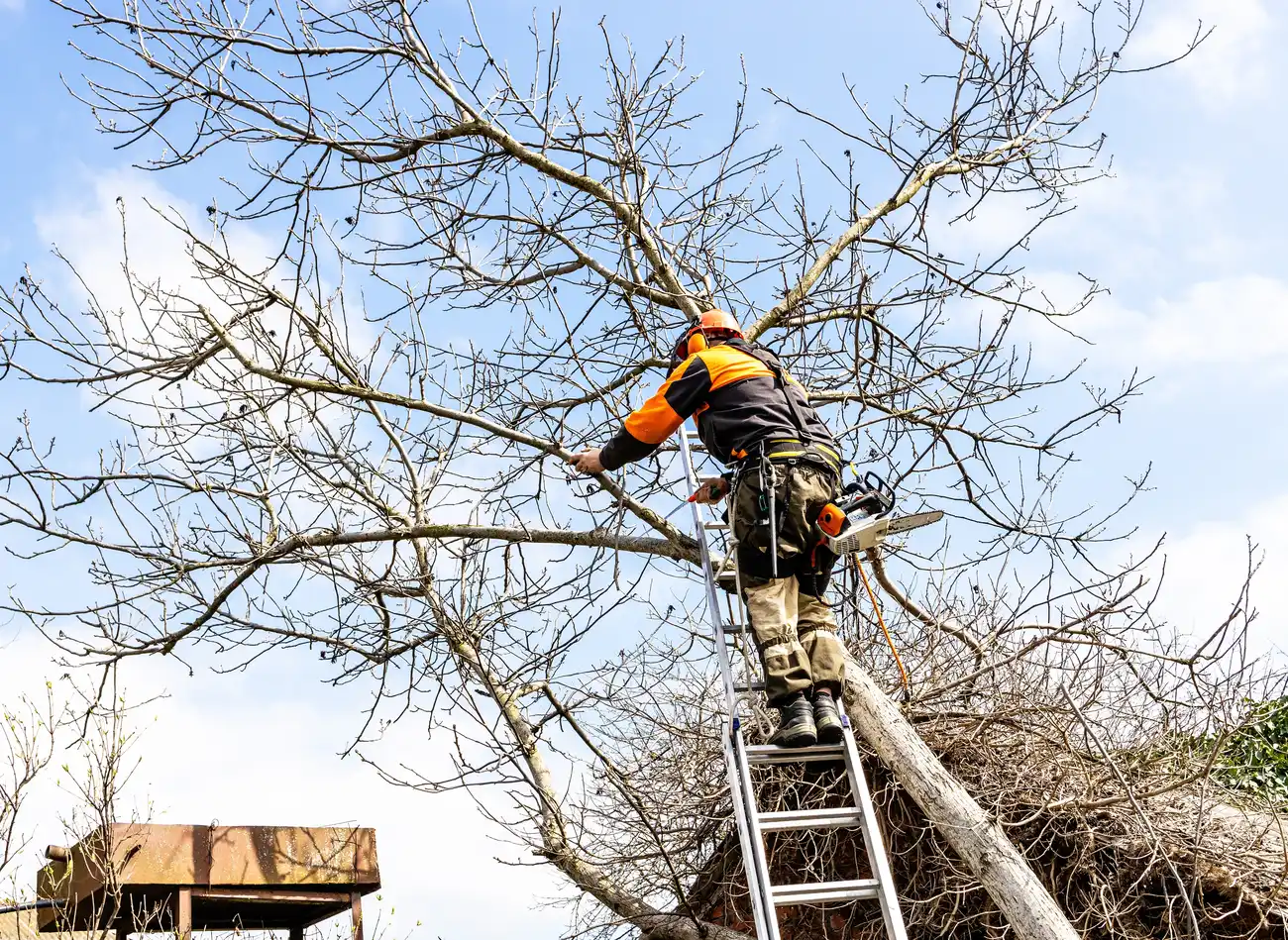
Texas tree service contractors operate in the largest state market in the country with one of the most distinctive workers’ compensation systems anywhere — Texas is the only state in the United States where workers’ compensation is voluntary. Combined with significant utility line clearance demand, hurricane and tornado exposure, year-round growing seasons in the south, and major metro tree service markets in Houston, Dallas-Fort Worth, San Antonio, and Austin, Texas presents unique opportunities and underwriting considerations.
This page covers what Texas tree service insurance typically includes, how Texas’s voluntary workers’ comp system works for tree care operations, and what carriers are actively writing Texas tree service business.
What Tree Service Insurance Costs in Texas
Texas tree service insurance pricing reflects two state-specific realities: the voluntary workers’ compensation system means tree service operations can either subscribe to traditional WC or operate as a “non-subscriber” with alternative coverage, and Texas’s massive geography creates significant pricing variation between metros.
The ranges below reflect what most Texas tree service contractors typically pay:
- General Liability Insurance: $850–$2,600 per year for typical Texas small operations. Houston metro and Dallas-Fort Worth operations typically pay slightly higher than Austin, San Antonio, and rural markets.
- Workers’ Compensation Insurance: $5–$11 per $100 of payroll for Texas tree service operations under class code 0106 — if you choose to subscribe. A crew with $200,000 of payroll typically pays $10,000–$22,000 annually for traditional WC. Texas is unique in that approximately 28% of private employers operate as “non-subscribers” instead. (See dedicated section below.)
- Commercial Auto Insurance: $1,800–$3,800 per truck per year for chip trucks, bucket trucks, and chipper-towing pickups. Pricing varies significantly by metro and rural exposure.
- Inland Marine (Equipment) Insurance: $400–$1,500 per year depending on total equipment value.
- Pesticide & Pollution Liability: $400–$900 per year for Texas tree services performing oak wilt treatments, herbicide applications, or other plant health care work.
- Umbrella / Excess Liability: $500–$1,300 per year for $1M of additional coverage above primary limits. Frequently required for utility line clearance contracts (CenterPoint Energy, Oncor, AEP Texas), municipal contracts in major metros, and commercial property work.
Texas’s combination of competitive market dynamics and the non-subscriber option means tree service contractors who structure their coverage strategically can often save 20–35% versus generic policies — but the structural decisions matter as much as carrier selection.
Workers’ Compensation in Texas: The Subscriber Decision
This is the section every Texas tree service owner needs to understand. Texas is the only state in the United States where workers’ compensation is voluntary for private employers. Approximately 28% of Texas private employers choose to operate as “non-subscribers” rather than carrying traditional workers’ compensation insurance.
Traditional WC Subscriber Path
If you elect to participate in the Texas workers’ compensation system, you carry a standard workers’ comp policy. This works essentially the same way it does in other competitive states:
- Tree service operations are classified under NCCI class code 0106
- Multiple private carriers compete for your business
- The exclusive remedy provision protects you from employee lawsuits over workplace injuries
- Specialty carriers focused on hazardous trades actively write Texas tree service business
- Experience modification (your “ex-mod”) affects your premium based on three-year claims history
- The Texas Division of Workers’ Compensation administers the system
Non-Subscriber Path
Texas employers who opt out of the workers’ compensation system are called “non-subscribers” or “bare employers.” This option is unique to Texas. Non-subscribers:
- Don’t pay traditional workers’ comp premiums
- Lose the exclusive remedy defense in workplace injury lawsuits
- Can be sued by injured employees for negligence — even minimal negligence can result in liability
- Must file annual notices (DWC Form-005) with the Texas Department of Insurance
- Must post workplace notices about non-subscriber status in English and Spanish
- Typically purchase alternative occupational accident plans to provide some employee benefits
Which Path Makes Sense for Tree Service?
For most tree service operations, the traditional WC subscriber path is the better choice. Tree service is consistently rated one of the most dangerous occupations in the country. The injury frequency and severity in tree care creates significant exposure for non-subscribers — the cost of even one serious injury lawsuit can far exceed years of WC premium.
Larger Texas tree service operations sometimes consider non-subscriber programs combined with strong safety programs and alternative occupational accident plans, but this requires careful structuring with experienced legal and insurance counsel. We don’t recommend non-subscriber status for most small to mid-size tree service operations.
General Liability
General liability (GL) is the foundation of every Texas tree care insurance program. A properly structured GL policy covers bodily injury and property damage claims arising from your operations.
Texas tree service GL policies are typically written with:
- Occurrence-based coverage (preferred over claims-made for most contractors)
- Completed operations coverage for claims that arise after a job is finished
- Contractors’ professional liability if you provide arborist consulting or recommendations
- Hurricane / windstorm coverage in Gulf Coast markets
Municipal contracts in Houston, Dallas, Austin, San Antonio, and Fort Worth regularly require $1M–$2M per occurrence. University of Texas, Texas A&M, Rice, SMU, and other major university campuses typically require $2M per occurrence. CenterPoint Energy, Oncor, AEP Texas, and other utility line clearance contracts often require $5M–$10M umbrella above primary GL.
Commercial Auto
Texas tree service companies typically run pickup trucks, dump trucks, bucket trucks, chippers, and stump grinders. Every commercial vehicle — including chippers and trailers towed on Texas roads — must be scheduled on a commercial auto policy.
Common coverage gaps we see in Texas programs:
- Chippers listed as trailers but never added to the schedule — a $60,000–$90,000 chipper is uninsured if it’s not explicitly listed
- Hired and non-owned auto — required if employees ever drive personal vehicles or rented trucks for company business
- Bucket trucks — confirm your policy covers the vehicle while the aerial function is in use
- Multi-state operations — Texas operations crossing into Oklahoma, Louisiana, New Mexico, or Arkansas need policies that extend coverage outside Texas
- Hurricane / comprehensive coverage — Gulf Coast operations need clear windstorm coverage on vehicles
Inland Marine / Equipment Floater
Texas crews typically carry $50,000–$200,000+ in portable equipment. An equipment floater covers your chainsaws, climbing gear, rigging, stump grinders, and other portable equipment on the job site, in transit, and in storage.
For Gulf Coast Texas operations, confirm your floater covers windstorm losses without exclusion or excessive deductibles.
Pesticide & Pollution Liability
The Texas Department of Agriculture’s Pesticide Programs licenses commercial pesticide applicators in Texas. If your operation includes oak wilt treatments, herbicide applications, soil injections, or any chemical application, a standard GL policy will not respond to resulting pollution claims. Contractor’s pollution liability (CPL) fills that gap.
Oak Wilt in Central Texas
Oak wilt is a particularly important issue for Texas tree services in the Hill Country and Central Texas regions. Treatment work using fungicide injections (propiconazole) is a substantial market. Operations performing oak wilt treatments specifically need pesticide and pollution liability coverage.
CPL is increasingly required by commercial and municipal clients in Texas as a condition of contract.
Umbrella / Excess Liability
An umbrella policy adds limits above your GL, commercial auto, and employer’s liability limits. For Texas tree service companies working on municipal right-of-way, university campuses, or utility line clearance for CenterPoint, Oncor, or AEP Texas, umbrella limits of $2M–$10M are frequently required.
A $1M umbrella typically costs a fraction of what your underlying GL costs — among the most efficient insurance purchases available.
Houston Crews and the Decision Texas Lets You Make
Texas is the one state where an employer can decline workers’ compensation entirely, and tree service owners in the Houston market ask about it constantly — usually because the quoted premium for a climbing crew is the largest number on the program. It is a real option with real consequences, and it deserves to be evaluated rather than assumed in either direction.
What declining actually costs you is the exclusive remedy. A subscribing employer’s exposure to an injured employee runs through the compensation system with defined benefits. A non-subscriber can be sued directly by an injured worker, and in that suit the common-law defenses an employer would normally rely on are stripped away. For a trade where a single incident can be catastrophic and life-altering, that is a substantial exchange for a lower monthly figure.
For Houston operations specifically, three factors weigh on the decision:
- The severity profile of the work. Climbing, rigging over structures, and hurricane-damaged trees produce the kind of injuries that generate large verdicts, not small ones. Frequency is manageable; severity is what ends companies.
- Who you want to work for. Commercial property managers, municipalities, utility contractors, and most general contractors require workers’ compensation as a condition of the contract. Declining coverage narrows the customer list, and it tends to narrow it toward the lower-margin end.
- Storm surge staffing. Gulf Coast operations scale crews fast after a named storm. Temporary crew members hired in a surge are exactly the population most likely to be injured, and an occupational accident plan structured for a steady eight-person crew may not behave the way the owner expects when the crew is twenty.
Operations that do subscribe should still get the underwriting details right — accurate payroll split between aerial and ground functions, disclosed storm-response radius, and a documented safety program. Those move the number more reliably than reconsidering the subscriber question every renewal.
Common Tree Service Risks in Texas
Texas’s geography and climate create distinctive risk patterns:
Hurricane and Coastal Storm Exposure
Houston, Galveston, Corpus Christi, and Brownsville sit in major hurricane corridors. Hurricane Harvey (2017), Hurricane Ike (2008), and more recent storms generate massive post-hurricane debris removal and tree work. Storm response is high-revenue but also among the highest-risk tree work performed.
Tornado Alley
North Texas (Dallas-Fort Worth, Wichita Falls) and Central Texas sit in tornado alley. EF-3 to EF-5 events create dangerous post-storm conditions for tree service operations responding to damage.
Severe Drought and Tree Mortality
Texas has experienced severe drought cycles (notably 2011 and the multi-year drought continuing into the 2020s) that have killed millions of trees across the state. Removal of dead and dying trees represents a substantial market — particularly post-mortem oak removal, which can be dangerous due to structural compromise.
Oak Wilt Devastation
Oak wilt has killed millions of Texas oaks across the Hill Country, Central Texas, and beyond. Treatment work (propiconazole injections) and removal of infected trees represents a substantial specialty market for Texas tree services.
Utility Line Clearance Demand
CenterPoint Energy (Houston metro), Oncor (DFW and most of North/Central Texas), AEP Texas (South Texas), and El Paso Electric run substantial vegetation management programs. Operations doing line clearance need higher liability limits, ANSI Z133 compliance, and specialized underwriting.
Aging Urban Canopy
Houston’s River Oaks, Tanglewood, and Memorial neighborhoods, Dallas’s Highland Park and Park Cities, Austin’s Tarrytown and West Lake Hills, and San Antonio’s Olmos Park and Alamo Heights have substantial mature tree populations near high-value homes. Tree work in these neighborhoods raises liability exposure significantly.
Year-Round Growing Season (South Texas)
South Texas, particularly the Rio Grande Valley, has near-year-round growing seasons that create sustained tree service demand without the winter dormancy that reduces work in northern markets.
Why Texas Tree Service Owners Choose TreeGuard
We understand the subscriber/non-subscriber decision. Most insurance agents either don’t understand Texas’s unique WC system or default to non-subscriber programs without understanding the litigation exposure. We help Texas tree service operations make this structural decision correctly.
We know Texas utility line clearance. CenterPoint, Oncor, and AEP Texas vegetation management contracts have specific underwriting requirements, and we know which carriers will write them.
As an independent agency, we represent 16+ A-rated carriers and shop your operation across the entire market. You’re not stuck with one company’s underwriting appetite or pricing — we find the carrier that best fits your specific Texas operation.
We specialize in tree care. We don’t write the occasional tree service policy as a side line — this niche is our focus.
Quote turnaround is fast. Most Texas tree service quotes come back within 1–2 hours during business hours.
Major Texas Markets We Serve
We write tree service insurance across all of Texas, with strong concentration in:
- Houston Metro: Houston, Sugar Land, The Woodlands, Pearland, Pasadena, Baytown, League City, Clear Lake, Katy, Cypress, Spring.
- Dallas-Fort Worth: Dallas, Fort Worth, Arlington, Plano, Frisco, Irving, Garland, McKinney, Allen, Denton, Lewisville, Carrollton, Richardson.
- Austin Metro: Austin, Round Rock, Cedar Park, Pflugerville, Georgetown, Kyle, Buda, Lakeway, West Lake Hills, Bee Cave.
- San Antonio Metro: San Antonio, New Braunfels, Schertz, Cibolo, Boerne, Universal City, Live Oak.
- Coastal Texas: Corpus Christi, Galveston, Beaumont, Port Arthur, Brownsville, McAllen, Harlingen.
- West Texas: El Paso, Lubbock, Amarillo, Midland, Odessa, Abilene.
- East Texas: Tyler, Longview, Marshall, Nacogdoches, Lufkin.
- Central Texas: Waco, Temple, Killeen, College Station-Bryan.
Whether you’re a single-truck operation in West Texas or a 50-employee crew working across the Houston metro, we can write your business in Texas.