

If you run a tree service company, there’s a four-digit number that has an enormous impact on what you pay for workers’ compensation insurance: 0106.
This is the NCCI class code assigned to tree pruning, trimming, repairing, spraying, and removal work. It’s the classification that your workers’ comp policy should be written under — and understanding how it works can save you from nasty surprises at audit time, help you manage your costs, and make sure your crew is actually covered when something goes wrong.
Here’s what every tree service owner needs to know.
What Is NCCI Class Code 0106?
The National Council on Compensation Insurance (NCCI) assigns numerical codes to job types to help carriers price workers’ comp consistently across the industry. Code 0106 covers:
- Tree pruning and trimming
- Tree removal and stump grinding
- Tree surgery and cabling
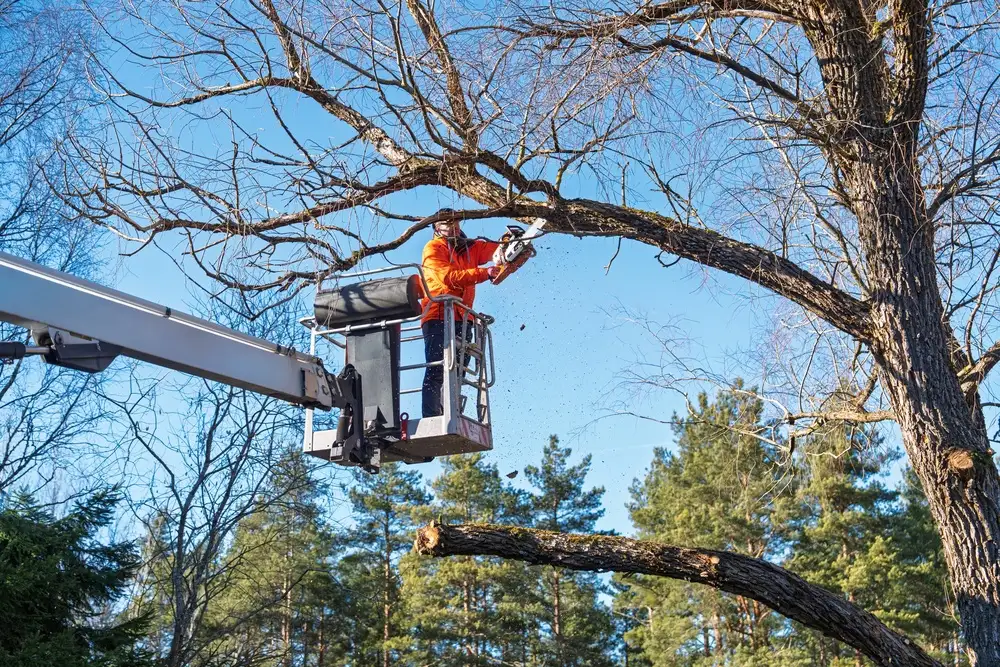
- Aerial and bucket truck operations
- Brush clearing and chipping
If your crews climb trees, operate chainsaws, or do aerial work — whether in a bucket truck or on rope and saddle — code 0106 is the right classification. NCCI uses it in most states, though a handful of states have their own independent bureaus that use slightly different systems.
The base rate for 0106 is among the highest in the workers’ comp world. That’s not arbitrary — it reflects the real injury risk of the work. Falls from height, chainsaw lacerations, struck-by incidents from falling limbs: tree care has a serious injury profile, and OSHA’s tree care safety standards document it extensively. Carriers price accordingly.
Why Your Classification Matters More Than You Think
Getting classified correctly matters for two big reasons: coverage and cost.
On the coverage side: If a claim occurs and your carrier discovers your policy was written under the wrong class code, they can dispute — or outright deny — coverage. Workers’ comp policies are priced on the risk being insured. If you told your carrier (or your carrier assumed) you were doing landscaping when you were actually doing full tree removal, that’s a material misrepresentation. You don’t want to find that out after a serious injury.
On the cost side: Your workers’ comp premium is calculated directly from your classification and payroll. Getting this wrong in either direction creates problems. Over-classifying inflates your premium unnecessarily. Under-classifying — intentionally or accidentally — creates liability at audit time when the carrier recalculates what you actually owe.
The Misclassification Trap: Code 0042 vs. Code 0106
The most common and most costly workers’ comp mistake in this industry is being written under code 0042 — the landscaping classification — when you should be under 0106.
Code 0042 covers light landscaping work: lawn maintenance, mowing, planting, mulching, light shrub trimming. The base rate for 0042 is significantly lower than 0106. Some agents — trying to win business on price — will write a tree service under a landscaping code because it makes the quote look cheaper. Some owners don’t realize the difference.
This creates serious problems:
At audit time: When your carrier audits your payroll (which they do every year), their auditor will look at what your crews actually do. If the work is clearly tree removal and aerial climbing but you’re on a landscaping code, the auditor will reclassify you — retroactively. That means a large additional premium bill, sometimes tens of thousands of dollars, due immediately.
When a claim happens: If an employee is injured doing tree work and your policy says you’re a landscaper, the carrier will investigate whether the work was consistent with what was disclosed. In a serious claim, this can create coverage disputes that take months to resolve and may leave your injured employee waiting for benefits they’re owed.
The right move is always to be classified correctly from day one.
How Tree Service Workers’ Comp Rates Are Calculated
Your workers’ comp premium has three core inputs:
1. Payroll by classification. The base formula is: (Class Code Rate × Payroll) ÷ 100. The rate is per $100 of payroll. If your 0106 rate is $15.00 per $100 and you have $500,000 in annual payroll, your base manual premium is $75,000.
2. Your experience modification factor (X-mod). Once your business has at least two to three years of claims history, NCCI calculates an experience modification factor — the X-mod — that adjusts your manual premium up or down based on your actual loss experience compared to expected losses for businesses your size. An X-mod of 1.00 is average. An X-mod of 0.80 means you pay 20% less than manual; a 1.25 means you pay 25% more.
A single serious lost-time claim can push your X-mod up significantly and keep it elevated for three years. That’s the compounding cost of a bad claim — not just the immediate payout, but the premium impact that follows.
3. Schedule credits and debits. Carriers can also apply credits (or debits) based on factors like your safety program, years in business, and claims history with that specific carrier. A strong safety culture and a track record of quick, effective claims management can help here.
How to Keep Your X-Mod Down
The X-mod is the most controllable variable in your premium over time. The biggest levers:
- Return-to-work programs. Getting injured employees back to light duty work quickly — even desk work or shop tasks — dramatically reduces the indemnity portion of claims, which is what drives X-mod increases most.
- Report claims immediately. Carriers handle quickly-reported claims better than late-reported ones. Delays can escalate costs significantly.
- Maintain an ANSI Z133-compliant safety program. The ANSI Z133 standard is the arboriculture industry’s safety bible. Having documented training and procedures demonstrates a commitment to risk management that carriers recognize — and it saves lives.
Premium Audits: What Triggers Them and How to Prepare
Workers’ comp policies are unique in that they’re based on an estimate of your payroll at the time of binding. At the end of the policy year, your carrier audits your actual payroll to calculate what the premium should have been. If you paid too little upfront, you owe the difference. If you paid too much, you get a credit.
Audits happen every year — they’re standard, not a sign of trouble. What you need to be ready for:
Payroll records. Your auditor will want clean payroll records broken down by classification. If you have employees doing both 0106 work and lower-rated work (like office staff or a dispatcher), those wages need to be tracked separately. You can’t commingle payrolls and expect the lower rate to apply across the board.
Subcontractor certificates. Any subcontractor you use must provide a current certificate of insurance showing their own workers’ comp coverage. If they can’t, your carrier will add their estimated payroll to your audit as if they were your employees — priced at your classification rate. This is a major audit surprise that catches operators off guard constantly.
Owner exclusions. In many states, sole proprietors and certain partners can exclude themselves from workers’ comp coverage. If you’ve done this, the documentation needs to be in order.
How to Manage Your Workers’ Comp Costs Long-Term
A few practical strategies:
Work with carriers who specialize in tree care. Not every carrier writes 0106 readily, and the spread between the best and worst rates in this class can be substantial. Carriers who have long underwriting experience with tree services understand the risk profile and price it more precisely — which usually means better rates for well-run operations.
Review your X-mod report annually. You can get a copy of your X-mod worksheet from NCCI or through your agent. It shows exactly what claims are driving your number and when they’ll drop off. If there are errors in the data — wrong amounts, miscoded claims — you can dispute them.
Don’t assume last year’s policy is still the best deal. Markets shift. Carriers enter and exit the class. Your loss history changes. Shopping your policy every year at renewal through an independent agent with access to multiple markets is simply good business.
Not sure if you’re being properly classified — or if you’re paying the right rate? Request a free quote and we’ll review your current policy, check your X-mod, and compare options from our carrier network. There’s no obligation and no pressure.

More from Coverage Explained

Ready to get properly covered?
Tell us about your tree care operation and we'll compare options across our carrier network. Quote response within 1–2 hours during business hours.
Independent agency · 16+ A-rated carriers · Licensed in 48 states