
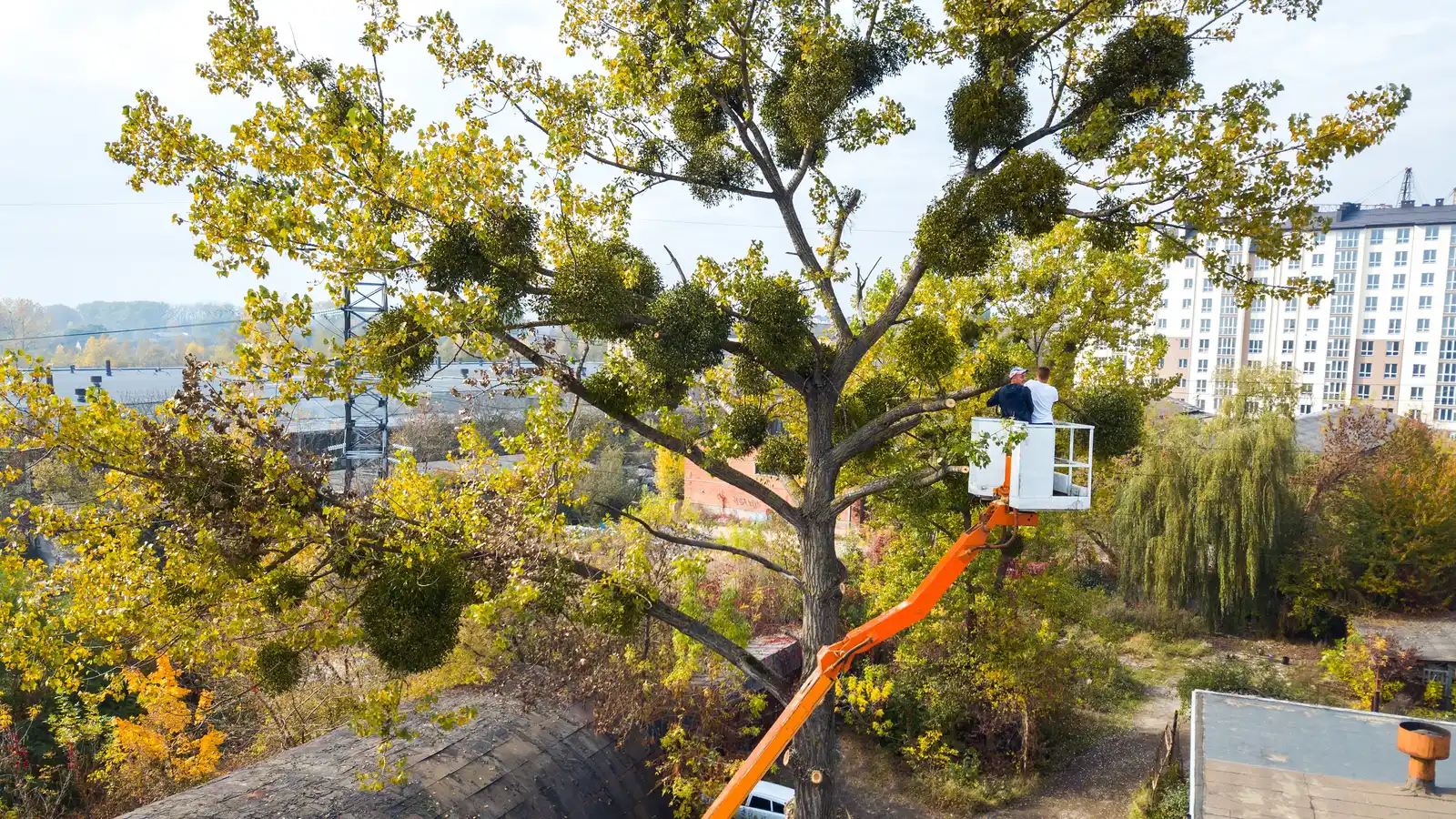
Arizona tree service contractors operate in one of the most unusual tree care markets in the country. The Phoenix metro — the fifth-largest city in the United States — sits in the low Sonoran Desert with native saguaro, palo verde, mesquite, and ironwood interspersed with imported palms, ash, citrus, and pine. The high desert and mountain markets around Flagstaff, Prescott, and Payson are dominated by ponderosa pine and juniper. Statewide, monsoon-season microbursts, extreme summer heat, wildfire risk in the north, and a unique regulatory regime around native plants combine to create a tree care market unlike any other in the West.
This page covers what Arizona tree service insurance typically includes, how Arizona’s strict one-employee workers’ comp threshold affects tree care operations, what state agencies regulate the industry, and what carriers are actively writing Arizona tree service business. For a broader walkthrough of coverage, see our coverage overview, or jump to workers’ compensation and pesticide & pollution for state-specific details.
What Tree Service Insurance Costs in Arizona
Arizona tree service insurance pricing reflects three state-specific realities: the strict one-employee workers’ comp threshold, the combination of low-desert and high-desert operating environments, and a substantial utility line clearance market across both the Phoenix and Tucson grids. Pricing varies meaningfully between Phoenix metro operations, Tucson operations, and the wildfire-exposed mountain markets.
The ranges below reflect what most Arizona tree service contractors typically pay:
- General Liability Insurance: $900–$2,600 per year for typical Arizona small operations. Phoenix and Scottsdale operations typically pay slightly higher than Tucson, Flagstaff, and rural markets due to claim frequency and dense urban canopy exposure.
- Workers’ Compensation Insurance: $7–$12 per $100 of payroll for Arizona tree service operations under class code 0106. A crew with $200,000 of payroll typically pays $14,000–$24,000 annually. Arizona is a competitive NCCI state with strong specialty carrier appetite.
- Commercial Auto Insurance: $1,800–$3,800 per truck per year for chip trucks, bucket trucks, and chipper-towing pickups. Pricing varies by metro and fleet size — Phoenix and Tucson rates exceed rural Arizona by 10–20%.
- Inland Marine (Equipment) Insurance: $400–$1,500 per year depending on total equipment value. Wildfire exposure in northern Arizona affects equipment storage location underwriting.
- Pesticide & Pollution Liability: $400–$900 per year for Arizona tree services performing herbicide applications, palm tree treatments, citrus operations, or other plant health care work.
- Umbrella / Excess Liability: $500–$1,300 per year for $1M of additional coverage above primary limits. Routinely required for APS, SRP, TEP, and municipal contracts across the major metros.
Arizona’s strict WC mandate combined with high-hazard 0106 rates means workers’ compensation is typically the single largest insurance line for tree service operations — making carrier selection and ex-mod management financially critical.
Workers’ Compensation in Arizona
Arizona has one of the strictest workers’ compensation mandates in the country. Every Arizona employer — regardless of size — must carry WC coverage for any employee. There is no small-employer exemption. A single-employee tree service operation in Arizona is legally required to carry WC.
Tree service operations in Arizona fall under NCCI class code 0106 — one of the highest-rated codes in the WC system. Arizona is a competitive NCCI state, meaning multiple private carriers underwrite the business and compete on price. The Industrial Commission of Arizona’s Workers’ Compensation Division administers the system and approves carrier filings.
Specialty WC carriers focused on hazardous trades actively write Arizona tree service business. For Arizona operations with $150,000+ of payroll, working with a specialty WC market typically produces 20–35% premium savings versus generic commercial lines carriers.
Heat-related illness deserves particular attention in Arizona WC programs. Phoenix and Tucson summer operations expose climbers and ground crews to severe heat stress. Robust hydration protocols, work/rest cycles, and heat illness prevention training reduce claim frequency and severity — and savvy underwriters reward operations that document these programs.
General Liability
General liability (GL) is the foundation of every Arizona tree care insurance program. A properly structured GL policy covers bodily injury and property damage claims arising from your operations.
Arizona tree service GL policies are typically written with:
- Occurrence-based coverage (preferred over claims-made for most contractors)
- Completed operations coverage for claims that arise after a job is finished
- Contractors’ professional liability if you provide arborist consulting or written recommendations
- Pool and water feature exposure endorsements where relevant (high-value Scottsdale and Paradise Valley properties)
Municipal contracts in Phoenix, Tucson, Mesa, Scottsdale, and Chandler regularly require $1M–$2M per occurrence. Arizona State University, University of Arizona, and Northern Arizona University typically require $2M per occurrence. APS, SRP, and TEP utility line clearance contracts often require $5M–$10M umbrella above primary GL.
Commercial Auto
Arizona tree service companies typically run pickup trucks, dump trucks, bucket trucks, chippers, and stump grinders. Every commercial vehicle — including chippers and trailers towed on Arizona roads — must be scheduled on a commercial auto policy.
Common coverage gaps we see in Arizona programs:
- Chippers listed as trailers but never added to the schedule — a $60,000–$90,000 chipper is uninsured if it’s not explicitly listed
- Hired and non-owned auto — required if employees ever drive personal vehicles or rented trucks for company business
- Bucket trucks — confirm your policy covers the vehicle while the aerial function is in use
- Multi-state operations — Arizona operations crossing into California, Nevada, Utah, New Mexico, or Colorado need policies that extend coverage outside Arizona
- Comprehensive / wildfire coverage — Northern Arizona operations need clear wildfire coverage on vehicles parked at job sites in fire-prone areas
Inland Marine / Equipment Floater
Arizona crews typically carry $50,000–$200,000+ in portable equipment. An equipment floater covers your chainsaws, climbing gear, rigging, stump grinders, and other portable equipment on the job site, in transit, and in storage.
Extreme heat affects equipment differently than cold-weather states — battery banks, hydraulic systems, and electronic ignition systems degrade faster in the Phoenix and Yuma summers. Underwriters consider equipment storage (climate-controlled vs. open yard) when pricing higher-value equipment schedules. Northern Arizona operations should confirm wildfire is not excluded on the floater, especially for equipment stored at remote job sites during fire season.
Pesticide & Pollution Liability
The Arizona Department of Agriculture’s Pest Management Division licenses commercial pesticide applicators in Arizona. If your operation includes palm tree treatments (Texas Phoenix palm decline, fusarium), systemic insecticide injections for ash or elm, herbicide applications, or any other chemical work, a standard GL policy will not respond to resulting pollution claims. Contractor’s pollution liability (CPL) fills that gap.
Saguaro and Native Plant Removal
The Arizona Native Plant Law regulates the removal, salvage, and transport of saguaro cacti, ironwood, palo verde, mesquite, and other protected native plants. Tree service operations doing development-site clearing, right-of-way work, or commercial removal projects involving these species must comply with permitting, tagging, and transport requirements. Improper handling can result in significant fines — and operations doing this work should ensure their GL clearly responds to native plant claims and that contracts allocate native-plant compliance risk appropriately.
Umbrella / Excess Liability
An umbrella policy adds limits above your GL, commercial auto, and employer’s liability limits. For Arizona tree service companies working on municipal right-of-way, university campuses, or utility line clearance for APS, SRP, or TEP, umbrella limits of $2M–$10M are frequently required.
A $1M umbrella typically costs a fraction of what your underlying GL costs — among the most efficient insurance purchases available.
Does Arizona License Tree Service Contractors?
Arizona handles this differently from states that created a dedicated tree classification. There is no Arizona equivalent of a tree-specific contractor license sitting on the shelf waiting to be pulled — the question is instead whether the work you are doing counts as contracting at all, and that turns on thresholds rather than on trade.
The Arizona Registrar of Contractors generally requires a license once the combined value of labor and materials exceeds one thousand dollars, or whenever a permit is required for the job regardless of value. The landscape-adjacent classifications sit under the hardscaping and irrigation headings rather than under anything named for trees. Because scope determinations turn on the specific work performed, an operation whose services sit near the boundary should ask the Registrar directly rather than reason by analogy from another state.
For insurance, the practical consequences are these:
Licensing status is verified, not assumed. Carriers check it at binding and expect it to remain valid through the term. An operation that believed it was under the threshold and turns out not to be has a licensing problem and a coverage problem simultaneously.
The threshold is low enough that most real jobs cross it. A single mature removal in Scottsdale or Paradise Valley will exceed it comfortably. Treating the exemption as an operating model rather than an edge case is how operators end up unlicensed on the jobs that matter most.
Desert conditions shape the exposure more than the paperwork does. Heat illness on summer crews, monsoon-season limb failure driving emergency call-outs, and palm work across the Phoenix and Tucson metros are what actually generate claims here. Operations should confirm palm trimming and removal is explicitly reflected in their operations description, since its hazard profile differs from broadleaf work.
Common Tree Service Risks in Arizona
Arizona’s geography and climate create distinctive risk patterns:
Monsoon Season Microbursts
Arizona’s July–September monsoon season produces violent localized microburst storms that snap mature trees and drop massive limbs. Phoenix-area monsoon damage generates a substantial portion of annual tree service revenue — but post-monsoon work involves unstable trees, hanging branches, and stressed root systems. Crews responding to monsoon damage need robust GL and WC structure.
Extreme Summer Heat
Phoenix and Tucson regularly exceed 110°F for weeks at a time in summer. Climbing, chainsaw, and chipper work in those conditions creates severe heat-illness exposure. Heat-related WC claims trend upward each summer, and underwriters increasingly request heat-illness prevention programs as a condition of binding coverage.
Wildfire in Northern Arizona
The Flagstaff, Prescott, Show Low, and Payson markets sit in significant wildfire corridors. The 2002 Rodeo-Chediski Fire, the 2010 Schultz Fire, and more recent events have shaped the wildfire mitigation market for tree service in northern Arizona. Defensible-space and forest thinning work is a substantial market — operations need clear coverage for wildfire-related work and equipment.
Native Plant Compliance Exposure
The Native Plant Law creates a regulatory exposure unique to Arizona. Operations doing land clearing, development site work, or right-of-way clearing need defined compliance procedures, contracts that allocate compliance risk, and insurance structure that responds to native-plant claims.
Palm Tree Operations
Phoenix, Scottsdale, and Tucson have substantial mature date palm, Mexican fan palm, and queen palm populations. Palm trimming and removal involves distinct hazards — frond cutters, sky-jack operations, and the structural unpredictability of palm trunks. Crews specializing in palm work need underwriting that understands the exposure.
Utility Line Clearance Demand
APS (Arizona Public Service), SRP (Salt River Project), and Tucson Electric Power run substantial vegetation management programs. Operations doing line clearance need higher liability limits, ANSI Z133 compliance, and specialized underwriting.
Why Arizona Tree Service Owners Choose TreeGuard
We understand Arizona’s strict one-employee WC mandate and high-hazard 0106 rate environment. Most insurance agents quote WC mechanically from a single carrier — we shop the specialty WC market and structure coverage to manage the largest line item on most Arizona tree service insurance programs.
We know Arizona utility line clearance. APS, SRP, and TEP vegetation management contracts have specific underwriting requirements, and we know which carriers will write them.
We understand the Native Plant Law and palm tree exposures. Most general-purpose commercial insurance agents have no familiarity with saguaro permitting, palm tree fall hazards, or wildfire-related defensible-space work. We do.
As an independent agency, we represent 16+ A-rated carriers and shop your operation across the entire market. You’re not stuck with one company’s underwriting appetite or pricing — we find the carrier that best fits your specific Arizona operation.
Quote turnaround is fast. Most Arizona tree service quotes come back within 1–2 hours during business hours.
Major Arizona Markets We Serve
We write tree service insurance across all of Arizona, with strong concentration in:
- Phoenix Metro / East Valley: Phoenix, Mesa, Chandler, Gilbert, Tempe, Queen Creek, Apache Junction.
- Phoenix Metro / West Valley: Glendale, Peoria, Surprise, Avondale, Goodyear, Buckeye, Litchfield Park.
- Scottsdale / Paradise Valley: Scottsdale, Paradise Valley, Fountain Hills, Cave Creek, Carefree.
- Tucson Metro: Tucson, Oro Valley, Marana, Sahuarita, Vail, Green Valley.
- Northern Arizona: Flagstaff, Sedona, Prescott, Prescott Valley, Cottonwood, Payson, Show Low, Pinetop-Lakeside.
- Yuma / Western Arizona: Yuma, Bullhead City, Lake Havasu City, Kingman.
- Casa Grande / Pinal County: Casa Grande, Maricopa, Coolidge, Florence.
Whether you’re a single-truck palm specialist in Scottsdale or a 40-employee crew working APS vegetation management across the West Valley, we can write your business in Arizona.