
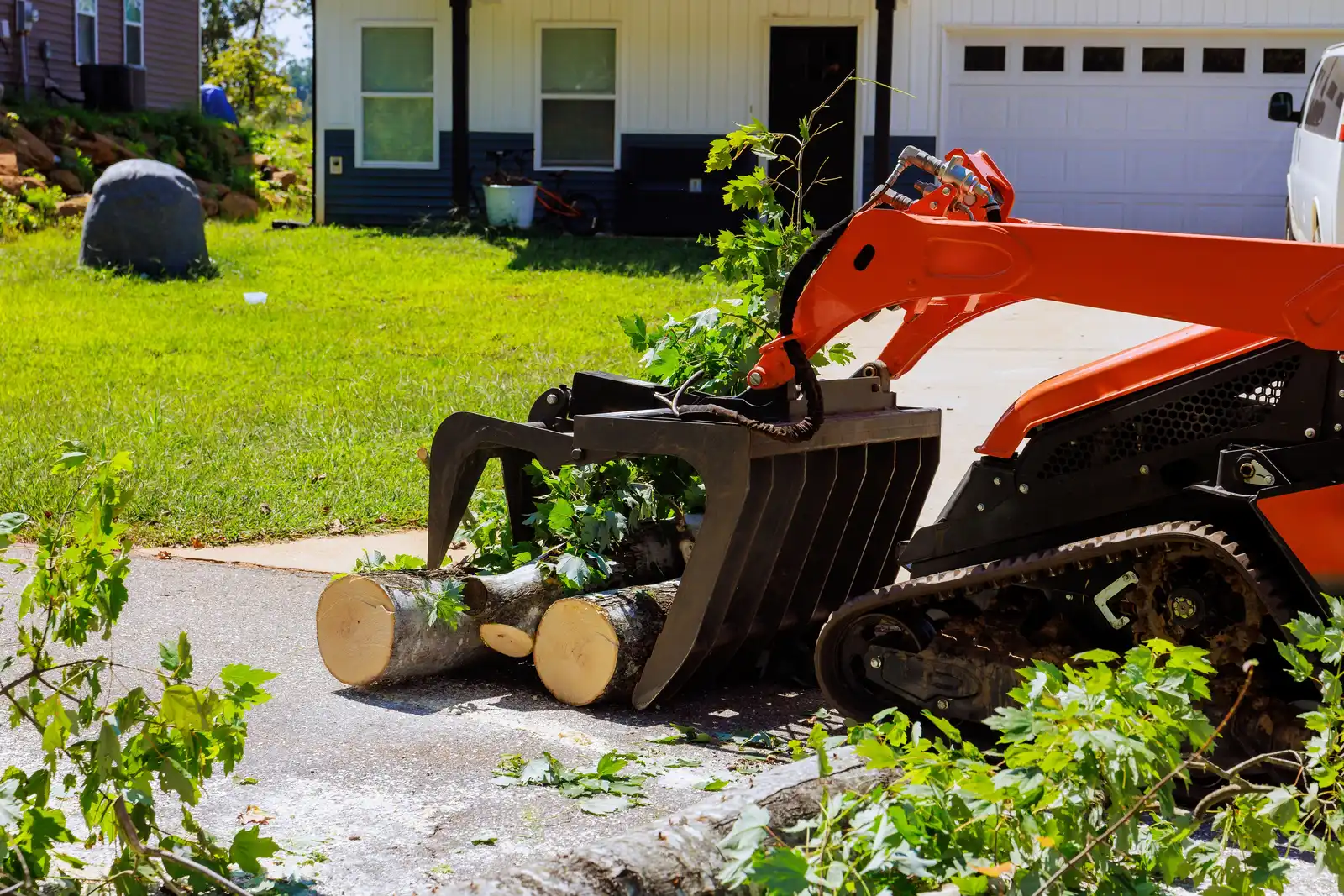
Inland marine insurance covers tree service equipment, tools, and gear while in transit, on job sites, and stored off-premises — protection that standard business policies often exclude or severely limit. For tree service contractors with $20,000 or more in portable tools and equipment (which is virtually every operating tree service), it’s an essential part of the coverage program that’s frequently overlooked until a theft or job-site loss happens.
This guide covers what inland marine actually is, what it covers for tree service operations, scheduled versus blanket approaches, real costs, and how to document your equipment before a claim occurs.
What “Inland Marine” Actually Means
The name is confusing and the history doesn’t help clarify it. Inland marine insurance originated in 19th-century marine insurance, which covered cargo on ships. As commerce expanded inland, the same concept extended to goods in transit overland — hence “inland” marine. The core principle is coverage for property that moves, rather than property fixed at a location.
For tree service operations, the application is direct: your equipment doesn’t sit in a fixed location. Chainsaws travel in trucks. Climbing systems go to job sites. Stump grinders get towed between locations. Rigging gets staged, used, and transported repeatedly. None of this equipment is covered by commercial property insurance (which covers property at a fixed business address) or by commercial auto (which covers the vehicles, not the portable equipment).
Inland marine — specifically a contractor’s equipment floater — covers portable business equipment wherever it is: in transit, on a job site, in a storage yard, or at a temporary location. That’s the gap it fills.
What Tree Service Inland Marine Covers
An inland marine equipment floater covers specifically scheduled equipment against most causes of physical loss or damage. Covered perils typically include:
Theft
Including theft from job sites, theft from locked vehicles, and theft from storage. Theft from an unlocked or unattended vehicle may be subject to additional conditions on some policies — verify this when quoting. Job-site theft of chainsaws, climbing hardware, and hand tools is among the most common inland marine claims in tree service.
Collision and Upset Damage
If your chipper is damaged in a towing accident, or a stump grinder tips off a trailer during transport, inland marine covers the physical damage. Commercial auto covers the liability from the accident. Inland marine covers the equipment. These policies work together — the gap exists only when inland marine isn’t in place.
Vandalism and Malicious Mischief
Equipment damaged by vandalism at a job site or storage location is covered. This includes graffiti, deliberate damage, and malicious acts against equipment left staged between job days.
Fire and Explosion
Equipment damaged or destroyed by fire — whether in a vehicle fire, a storage facility fire, or a job-site fire — is covered.
Mysterious Disappearance
Some inland marine policies cover mysterious disappearance — equipment that can’t be found with no clear evidence of theft. Policies vary significantly on this; it’s worth asking about explicitly.
Specific Equipment Covered
For tree service operations, a properly structured equipment floater covers:
- Chainsaws — typically $800–$2,500 each; a crew may carry 3–6
- Climbing systems — harnesses, saddles, lanyards, ropes — $1,500–$4,000 per climber
- Rigging equipment — blocks, redirects, lowering devices, rigging lines — $2,000–$8,000 per crew
- Stump grinders — $8,000–$60,000+; often the highest single scheduled item for smaller operations
- Hand tools — axes, hand saws, pruning equipment — $500–$2,000
- Wood chippers — chippers not attached to a commercial auto schedule; $25,000–$120,000+
- Aerial lift attachments and bucket truck accessories — $5,000–$30,000
- PPE equipment — helmets, face shields, chaps — $200–$500 per worker
A full crew’s portable equipment often totals $50,000–$200,000+. A total theft or fire loss at that scale without inland marine is a business-threatening event.
Scheduled vs. Blanket Coverage
Scheduled coverage lists each piece of equipment individually with its insured value. You get exact coverage for each item at its full scheduled value. The advantages: no ambiguity at claim time, no co-insurance requirements, and clear documentation. The disadvantage: requires maintaining an up-to-date schedule as equipment is acquired or disposed of.
Blanket coverage insures all qualifying equipment up to a single blanket limit without itemizing each piece. Simpler to administer, but introduces the risk that your blanket limit is too low if you experience a total loss. Some blanket policies also have per-item sub-limits that cap payment on any single item at a fraction of the blanket limit.
For most tree service operations, scheduled coverage is the better choice. The equipment is high-value, easily enumerable, and worth tracking precisely. The per-item accuracy prevents both underinsurance on high-value items and the disputes that arise from blanket policies when a large claim is filed.
What’s Excluded
Even comprehensive inland marine policies have exclusions that matter:
Wear and tear. Gradual deterioration, rust, corrosion, and normal wear aren’t covered. A chainsaw with a worn bar and chain that’s damaged further in use isn’t an inland marine claim.
Mechanical breakdown. Equipment that fails mechanically — motor failure, hydraulic failure, electronic failure — isn’t covered by inland marine. Mechanical breakdown coverage is a separate policy or endorsement.
Employee theft. Standard inland marine policies typically exclude theft by your own employees. Employee dishonesty or crime coverage is a separate policy. This exclusion surprises contractors who discover a chain of equipment disappearances was actually employee theft.
Property of others (without endorsement). Equipment owned by customers or others that’s in your care is typically not covered unless specifically endorsed.
Extremely high-value items below scheduled value. If you schedule a chipper at $40,000 but its replacement cost is $80,000, inland marine pays $40,000 at a total loss. Accurate scheduled values matter.
Inland Marine Cost for Tree Service in 2026
Inland marine premiums are driven by total equipment value, types of equipment, storage security, loss history, and operations geography. Typical annual ranges:
| Equipment Schedule Value | Annual Premium Range |
|---|---|
| $20,000–$50,000 | $400–$900/year |
| $50,000–$100,000 | $700–$1,500/year |
| $100,000–$200,000 | $1,200–$2,500/year |
| $200,000+ | $2,000–$4,000+/year |
Replacement cost coverage (which pays the cost to buy new equivalent equipment) typically costs 15–25% more than actual cash value (which pays depreciated value). For active operational equipment, replacement cost is almost always the right choice — ACV on a 5-year-old chipper may be $25,000 when replacing it costs $80,000.
For total program cost context, see our insurance cost guide.
How to Document Your Equipment for Claims
A pre-loss equipment inventory dramatically accelerates claim settlement and reduces disputes. Maintain:
- Equipment list with description, make, model, serial number, and purchase price for every scheduled item
- Purchase receipts or invoices for high-value items
- Photos of each significant piece of equipment — stored off-site (cloud storage, email to yourself)
- Current replacement cost estimates — actual replacement cost today, not what you paid 3 years ago
Update the inventory whenever you purchase or dispose of significant equipment. An inventory maintained before a loss is powerful evidence in a claim; trying to reconstruct it after a theft is time-consuming and incomplete.
How Inland Marine Fits Your Full Coverage Program
Inland marine is the equipment layer in a complete tree service program:
- General liability — third-party bodily injury and property damage (GL coverage guide)
- Workers’ compensation — employee injuries (WC guide)
- Commercial auto — vehicle accidents (commercial auto guide)
- Inland marine — tools and equipment wherever they are (this guide)
- Pesticide/pollution — chemical application claims (pesticide guide)
- Umbrella — additional limits above all primary policies
The commercial auto / inland marine boundary is where confusion most often creates gaps. Knowing exactly which policy covers which item prevents discovering the gap at claim time.
External references: TCIA provides industry resources on equipment standards and safety, and ISA covers the professional standards that inform proper equipment maintenance documentation.
Frequently Asked Questions
What’s the difference between inland marine and commercial property insurance?
Commercial property covers equipment and contents at a fixed location — your shop or storage yard. Inland marine covers equipment that moves — in transit, on job sites, and at temporary locations. Tree service equipment is almost never at your fixed location during working hours, which is why inland marine is the correct coverage rather than commercial property.
Does inland marine cover my chainsaw if it’s stolen from my truck?
Yes — theft from a locked vehicle is typically covered under an inland marine equipment floater. Verify your policy doesn’t contain a “theft from unattended vehicle” exclusion. Most specialty tree service inland marine policies cover locked-vehicle theft as a standard covered peril.
How much inland marine coverage do I need?
You need coverage equal to the replacement cost of all portable equipment you’d need to resume operations after a total loss. For most single-crew operations: $30,000–$100,000. Multi-crew operations with multiple chippers, stump grinders, and full climbing systems: $150,000–$300,000+.
Does inland marine cover rented or borrowed equipment?
Standard equipment floaters cover equipment you own. Rented or borrowed equipment typically requires a separate “leased or rented equipment” endorsement. Add this if you frequently rent equipment for specific jobs.
Does my commercial auto policy cover the chipper I’m towing?
Commercial auto covers liability from towing accidents but not physical damage to the chipper. The chipper needs to be scheduled on an inland marine floater for collision, theft, and physical damage coverage. This is one of the most common uncovered gaps in tree service.
How do I file an inland marine claim for stolen equipment?
File a police report immediately — required by most insurers. Document what was stolen with serial numbers and purchase records. Notify your insurer within the policy-specified timeframe (typically 24–72 hours). Provide a signed proof of loss with replacement cost documentation. A pre-existing equipment inventory with serial numbers makes this process significantly faster.

More from Coverage Explained
Ready to get properly covered?
Tell us about your tree care operation and we'll compare options across our carrier network. Quote response within 1–2 hours during business hours.
Independent agency · 16+ A-rated carriers · Licensed in 48 states