Inland Marine Insurance for Tree Care Equipment

Your chainsaws, climbing gear, and specialty equipment are your livelihood. Inland marine coverage protects them wherever your work takes you — on the job, in the truck, or in storage.

Get a Free Quote
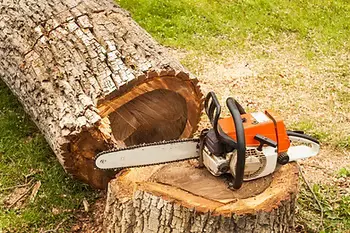
Chainsaw resting on a freshly cut tree stump after a removal job

What Is Inland Marine Insurance?

Despite the name, inland marine insurance has nothing to do with boats. It's a broad category of coverage designed for property that moves — equipment, tools, and materials that aren't tied to a fixed location like a building or warehouse.

For tree care contractors, inland marine is most commonly written as a contractor's equipment floater. This policy "floats" with your equipment, covering it on the job site, while being transported in or on your vehicle, and at storage locations. It fills the gap left by commercial auto (which covers vehicles on the road, not the tools inside them) and commercial property insurance (which only covers property at a fixed address).

A tree care operation without an equipment floater has a significant uninsured exposure. Chainsaw theft from a job site, a grinder damaged during transport, climbing gear destroyed in a truck fire — none of these are covered by auto or GL. Inland marine is the policy designed for exactly these scenarios.

Blanket vs. Scheduled Coverage

Equipment floaters are written two ways, and the distinction matters:

Blanket coverage insures your entire equipment inventory up to a total limit, often with a per-item sub-limit. For example, a $100,000 blanket limit with a $10,000 per-item maximum. Blanket coverage is simpler to manage — you don't need to update the policy every time you buy a new saw — but the per-item cap can leave you short if a high-value piece is lost.

Scheduled coverage lists each piece of equipment individually with its own insured value. It's more precise and ensures full replacement cost on specific high-value items, but requires active management as your inventory changes.

Many tree care operations benefit from a hybrid approach: blanket coverage for hand tools and smaller equipment with specific scheduling for high-value items like aerial lifts and larger grinders.

Replacement Cost vs. Actual Cash Value

This is one of the most important distinctions to understand when buying equipment coverage. Actual Cash Value (ACV) pays you what the equipment was worth at the time of loss — depreciated. If your three-year-old saw is stolen, you get three-year-old-saw money, not enough to buy a new one.

Replacement Cost Value (RCV) pays to replace the item with a new equivalent. For equipment you depend on daily, RCV is almost always worth the additional premium. Ask specifically which basis applies to your policy.

Common Equipment in Tree Care Programs

Most tree care equipment qualifies for inland marine coverage. Here's what we typically see in tree care equipment floaters.

Chainsaws & Cutters

Stihl MS 661, MS 500i, Husqvarna 572 XP, pole saws, loppers

Climbing & Rigging

Ropes, harnesses, saddles, carabiners, rigging blocks, pulleys, friction devices

Aerial Lifts

Spider lifts, articulating lifts, towable booms not scheduled on auto

Stump Grinders

Walk-behind and ride-on grinders, track units, trailer-mounted units

Wood Chippers

Drum and disc chippers scheduled as equipment rather than trailers

Hand Tools & Power Tools

Drills, impact drivers, hand saws, pruning tools, spray equipment

Communication Equipment

Radios, GPS units, tablets, laptops used in the field

Safety Equipment

Hard hats, hearing protection, eye protection stored in trucks or job sites

Getting the Most From Your Equipment Coverage

  • Maintain a current equipment inventory. Know what you own and what it's worth. An up-to-date list makes it much easier to buy the right amount of coverage and file a claim when needed.
  • Don't underinsure to save on premium. Choosing a blanket limit below your actual equipment value to reduce premium leaves you exposed to a co-insurance penalty at claim time.
  • Check your deductible options. Equipment floater deductibles typically range from $500 to $2,500. A higher deductible reduces premium but means more out-of-pocket on small claims.
  • Photograph and serial-number your high-value equipment. This significantly speeds up the claims process and helps establish proof of ownership.
  • Ask how theft from an unattended vehicle is handled. Some policies require signs of forced entry for vehicle theft claims. Know the requirement so you're not caught off guard.

Equipment Coverage by State

We write inland marine equipment floaters for tree care contractors in 48 states. Carrier options and rates vary by location — select your state or call for a quote.

View All State Guides
Indiana Illinois Ohio Michigan Kentucky Tennessee Texas Florida Georgia North Carolina Pennsylvania New York + more states

Get a Quote for Your Tree Care Equipment

We'll help you structure a floater that covers your actual inventory — not a generic number that leaves gaps when something goes wrong.