
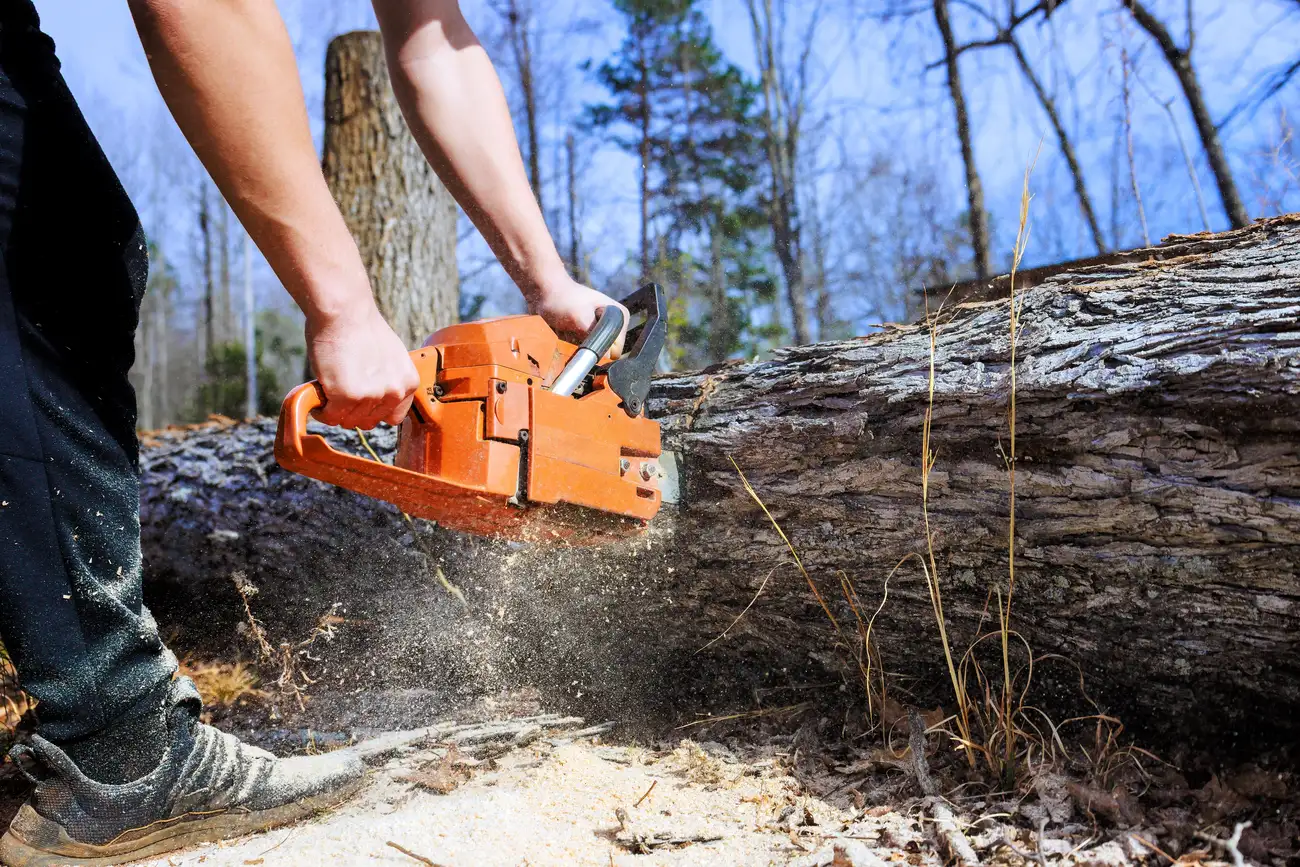
Montana tree service operations work at a scale that distorts every assumption borrowed from a smaller state. A single service area can span several counties. A crew can spend more of its day driving than cutting. And the tree population runs from irrigated urban canopy in Billings and Missoula to standing beetle-killed conifer on the western slopes, which are not the same trade even though one truck does both.
The insurance side has its own Montana shape. Workers’ compensation is not a single product here but a choice among three statutory plans, the state agriculture department will not issue an applicator license until it has seen proof of liability insurance, and the contractor registration system that operators knew for years was replaced by a licensing program at the start of 2026. This page covers what a Montana tree service program includes and where the state-specific decisions actually are.
What Tree Service Insurance Costs in Montana
Montana is an NCCI jurisdiction, so tree work rates under class code 0106, and it is a competitive state with both private carriers and a state fund bidding for the same accounts. Pricing tends to move on working radius, the share of revenue coming from mortality and fire-damaged removals, and whether the operation holds an applicator license.
The ranges below reflect what most Montana tree service contractors typically pay:
- General Liability Insurance: $850–$2,500 per year for a typical Montana small operation. Flathead and Gallatin valley work near high-value residential property tends to sit at the upper end.
- Workers’ Compensation Insurance: $7–$13 per $100 of payroll under class code 0106. A worked example: a crew with $200,000 of payroll typically pays $14,000–$26,000 annually.
- Commercial Auto Insurance: $1,900–$3,900 per truck per year. Montana radius exposure is the single biggest driver here — a fleet that runs three counties is not rated like a fleet that runs three neighborhoods.
- Inland Marine (Equipment) Insurance: $400–$1,500 per year depending on schedule value, with outdoor and between-day storage the conditions worth reading.
- Pesticide & Pollution Liability: $400–$900 per year. Note that the state already requires a liability minimum before licensing, so this coverage is frequently a compliance item rather than an option.
- Umbrella / Excess Liability: $500–$1,300 per year for a first excess layer, usually bought because a municipal, utility or resort contract asks for it.
Because Montana lets an operation put Plan 2 and Plan 3 side by side, the workers’ compensation line is genuinely shoppable, and a clean loss history converts into money more directly here than in states with administered rates. For the factors that apply in every state, see the national cost guide.
Workers’ Compensation in Montana
MCA § 39-71-401 applies the Workers’ Compensation Act to employers generally and then requires an employer with any employee under a contract of hire to elect coverage under compensation plan No. 1, No. 2 or No. 3.
Those three plans are the whole structure:
- Plan 1 — self-insurance. Requires approval and security. Almost no tree service qualifies or wants to.
- Plan 2 — a private carrier policy. The open market, where a safety record and a well-built submission are worth something.
- Plan 3 — Montana State Fund. A competing state fund, not a monopoly. It writes a large share of Montana employers and functions as the guaranteed market.
The common exemptions run to owners rather than crews: sole proprietors, working partners, working members of a limited liability partnership, and working members of a member-managed LLC, along with a person working under an independent contractor exemption certificate. An owner-operator can therefore be outside the act while the first groundman hired puts the business inside it.
Class Code 0106 and the Landscape Code Problem
Tree pruning and removal classify under 0106. The persistent error is initial placement under 0042, landscape gardening, which carries a lower base rate and does not describe the work. Audits find it, and the correction is retroactive premium rather than a forward-looking adjustment.
Montana Replaced Contractor Registration With Licensing on January 1, 2026
Operators who looked this up two years ago found a registration system. That system is gone.
House Bill 239 of the 2025 session, enacted as Chapter 644, repealed MCA §§ 39-9-201 and 39-9-204 and moved construction contractors into a department licensing program, with a delayed effective date of January 1, 2026. Anything published before that date describing Montana contractor registration is describing a repealed scheme, which is worth knowing because a fair amount of guidance online still does.
What did not change is the boundary. A construction contractor is still defined by work performed on a building, highway, road, railroad, excavation or other structure, project, development or improvement attached to real estate. Searching the enacted text for tree, arborist and landscaping returns nothing. Pruning, removal and stump grinding are not construction, and an operation doing only that work is outside the licensing program on the face of the definition.
The line matters for mixed operations. A tree service that also builds landscape retaining walls, does grading, or performs land clearing as part of a construction project is doing construction alongside tree work, and the licensing question attaches to that half. Insurance follows the same split — the construction side may carry contract requirements the tree side never triggers.
General Liability
General liability answers bodily injury and property damage arising out of Montana tree operations: a limb through a roofline, a rigging failure that reaches a vehicle, a member of the public who walks into a drop zone.
Policies here are usually occurrence-based with completed operations included, which is what keeps a delayed failure inside coverage after the crew has moved on. Operations that write assessments or recommend retention versus removal are giving professional advice, and that belongs on a professional liability form rather than being assumed into the general liability policy.
Set limits against the property in the fall zone. In Whitefish, Big Sky and the Bozeman corridor that property is frequently worth many multiples of an operation’s annual revenue.
Commercial Auto
A Montana fleet is a pickup, a chip truck, sometimes an aerial unit, and a string of towed equipment covering long distances on two-lane roads and winter surfaces.
The recurring gaps:
- Towed chippers and grinders described at binding but never added to the schedule, leaving expensive machines uninsured while in transit
- Hired and non-owned coverage omitted where employees drive personal vehicles between distant job sites, which is routine practice in Montana
- Aerial devices insured as vehicles with nothing addressing the boom while it is deployed
Winter driving and wildlife strikes are Montana constants that show up in loss runs, and comprehensive coverage on a chip truck is not the place to economize when a single collision can idle the operation for a season.
Inland Marine / Equipment Floater
The floater covers portable property wherever the work takes it — and in Montana the work takes it a long way from the shop, often for several days at a stretch.
Two provisions deserve attention. First, whether the policy accepts equipment stored outdoors or left on site between working days, because both are normal practice here. Second, replacement cost rather than actual cash value, since machinery that lives through Montana winters depreciates on paper faster than it does in usefulness.
Pesticide & Pollution Liability
The Montana Department of Agriculture licenses commercial pesticide applicators, and Montana is unusual in tying licensure directly to insurance. A commercial applicator must show financial responsibility before the license issues, and the department sets that floor as liability insurance of $30,000 for ground applicators and $50,000 for aerial applicators under Administrative Rules of Montana 4.10.101 through 4.10.104, with seed treatment and certain ground-bait vertebrate control excepted.
That statutory minimum is a licensing floor, not a sensible limit. It bears no relationship to what a drift event onto an organic operation or a riparian corridor actually costs. Standard general liability excludes pollution, so the form that answers a misapplication is contractors’ pollution liability, and it should be sized against Montana’s water — the Clark Fork, the Yellowstone and the irrigation systems feeding off them carry a mistake much further than a lawn does.
Umbrella / Excess Liability
An umbrella adds limit above general liability, commercial auto and employer’s liability together. Montana operations usually buy one because a contract demands it — resort and municipal work in Gallatin and Flathead counties, utility vegetation management, and institutional accounts in Missoula and Bozeman are the common triggers.
The economics are the same everywhere and still persuasive: a first excess layer costs a fraction of the primary limits beneath it, which makes it the cheapest available correction to a limit that was set when the operation was smaller.
The License Montana Will Not Issue Until It Sees Your Certificate
Most states treat pesticide licensing and insurance as two separate errands. Montana staples them together, and operations that learn this late lose a season of plant health care revenue.
The sequence catches people out because it runs backward from what they expect. An owner decides to add treatment work, books the exam, passes the core and category sections, and then finds the license will not issue because the department has not seen proof of financial responsibility. Insurance was supposed to be the paperwork that followed the license. In Montana it is a precondition of it.
Three consequences follow, and they are worth planning around:
- The timing is the whole problem. Placing pollution coverage is not instant, particularly for an operation with no application history, which is exactly the operation applying for a first license. Starting the insurance conversation before the exam rather than after it is the difference between treating in the spring and treating the following spring.
- The statutory minimum is not a recommendation. A $30,000 floor is a licensing threshold. A drift claim reaching a neighboring agricultural operation, a certified organic field, or a stream corridor moves past that figure without difficulty, and the operator is personally exposed above it.
- The exceptions are narrow. Seed treatment and some ground-bait vertebrate work sit outside the requirement. Tree and ornamental application does not, so no tree service should expect to be carved out.
The upside is that an operation which handles this correctly arrives at the underwriter already documented. A licensed applicator with clean records and a real understanding of the rule is a better submission than one presenting plant health care as an afterthought, and it prices accordingly.
Common Tree Service Risks in Montana
Beetle-Killed and Fire-Damaged Standing Timber
Large areas of western Montana carry mortality from bark beetle activity and past fire. Dead stems do not hinge predictably, tops break loose during rigging, and visual assessment from the ground is unreliable. This is the state’s signature high-severity work.
Wildland-Urban Interface Growth
Residential development has pushed into forested ground around Kalispell, Whitefish, Missoula and Bozeman. Defensible space and hazard removal work puts crews on steep terrain with expensive structures directly beneath the work.
Chinook Wind and Downslope Events
Sudden warm downslope wind events along the Rocky Mountain Front produce concentrated windthrow and limb failure, generating emergency call-outs where crews work damaged, loaded trees under time pressure.
Heavy Snow and Ice Loading
Winter loading breaks limbs and splits codominant stems across the state. The resulting removals are frequently structural failures in progress rather than routine work.
Long Response Distances
Rural work means the interval between an injury and definitive care is measured in a way it is not in urban states. That interval drives claim severity, and it is why communication planning and evacuation routes belong in the safety program.
Cottonwood and Riparian Work
River corridors across eastern and central Montana carry mature cottonwood — fast-grown, weak-wooded, and prone to large-diameter limb drop near the recreation areas and campgrounds where people are.
Why Montana Tree Service Owners Choose TreeGuard
We put Plan 2 and Plan 3 side by side. Montana gives operations a real choice on workers’ compensation, and the only way to use it is to actually market the account rather than renewing whatever is in place.
We handle the applicator insurance requirement as a sequencing problem, not a surprise. If an operation intends to add plant health care, the coverage conversation belongs before the exam.
As an independent agency we represent 16+ A-rated carriers and shop the market rather than defending one appetite. For an operation with a clean record and long working distances, that difference is measurable.
We write tree care and nothing else. That is why the class code is right at binding, why the boom question gets asked about the aerial unit, and why a certificate for a resort contract goes out without a week of back and forth.
Most Montana submissions are quoted within one to two business hours.
Major Montana Markets We Serve
We write tree service insurance statewide, with concentration in:
- Billings and the Yellowstone Valley: Billings, Laurel and Lockwood — the largest urban canopy in the state, plus riparian cottonwood work.
- Gallatin Valley: Bozeman, Belgrade, Big Sky and Livingston — rapid residential growth against forested ground, resort contracts, and high property values.
- Flathead Valley: Kalispell, Whitefish, Columbia Falls and Bigfork — lake frontage, interface development, and heavy mortality removal.
- Missoula and Western Montana: Missoula, Hamilton and the Bitterroot — university and municipal work alongside interface fuels reduction.
- Helena and Butte: state government and institutional accounts, older urban canopy, and mining-era residential neighborhoods.
- Great Falls and the Front: Great Falls, Conrad and Choteau — downslope wind exposure and agricultural windbreak work.
Whether the operation runs one truck out of the Bitterroot or several crews across the Hi-Line, we can place it in Montana.