
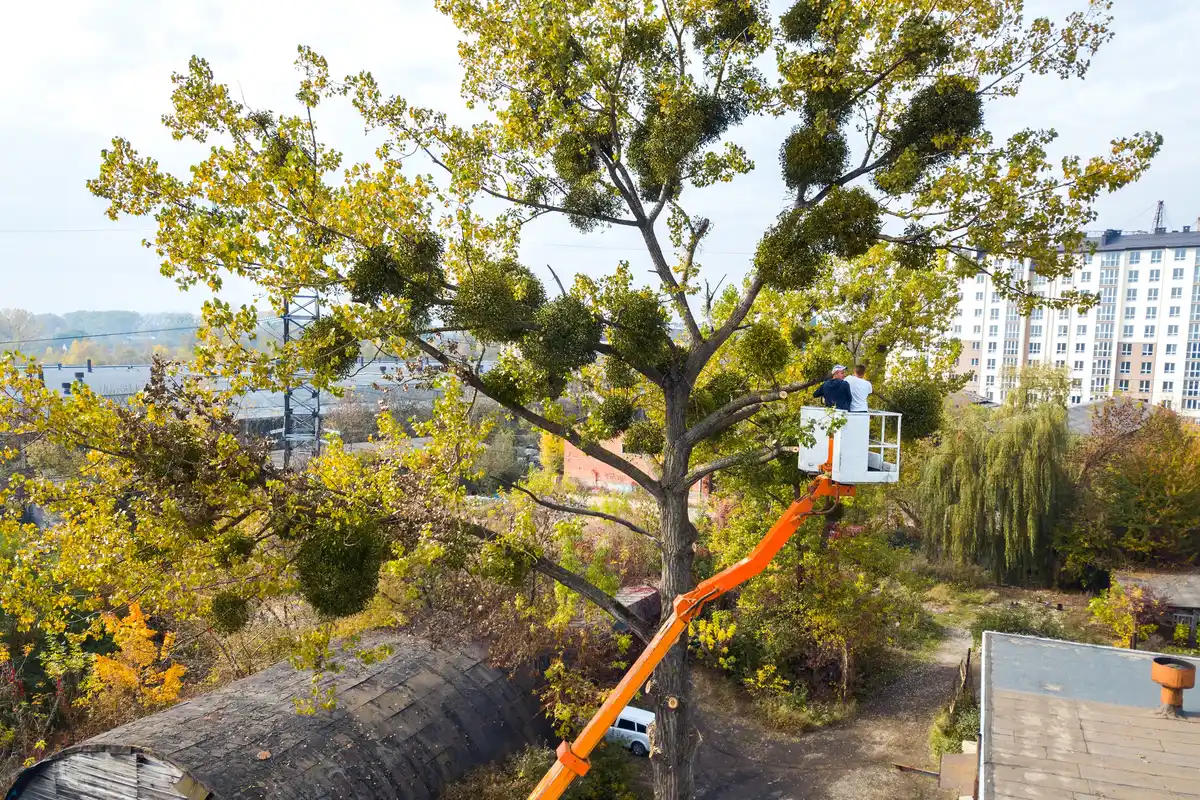
North Dakota tree care runs on a canopy that is almost entirely deliberate. The Red River Valley towns — Fargo, Grand Forks, Wahpeton — carry dense, mature street plantings on ground that was tallgrass prairie and lakebed. West of the Missouri the trees thin to draws, coulees and river bottom, and the working canopy is farmstead grove and shelterbelt row. Native forest exists in the Turtle Mountains and the Pembina Gorge and almost nowhere else.
The insurance structure is where the state departs hardest from expectation. Workers’ compensation cannot be bought from a carrier, cannot be self-insured, and is not rated on the class code system the rest of the trade uses — North Dakota shares the first with three other states and the second with only one. Those facts change what the rest of the program must accomplish, because coverage a private compensation policy quietly includes is absent here until it is bought on purpose. This page covers that structure, the gap it creates, and the exposures of working this landscape.
What Tree Service Insurance Costs in North Dakota
North Dakota pricing splits cleanly. Workers’ compensation is set by the state and is not shoppable in any degree. Everything else — general liability, commercial auto, equipment, pollution and excess — is written in an ordinary competitive market where presentation and loss history do the work.
The ranges below reflect what most North Dakota tree service contractors typically pay:
- General Liability Insurance: $850–$2,500 per year for a typical North Dakota small operation. Fargo and West Fargo work sits at the upper end, where mature canopy stands over closely spaced older housing.
- Workers’ Compensation: $5–$13 per $100 of payroll — a WSI figure, attached to the classification the agency assigns at registration, with no carrier, no NCCI manual and no bid behind it. A worked example: a crew with $200,000 of payroll typically pays $10,000–$26,000 annually.
- Commercial Auto Insurance: $1,900–$3,900 per truck per year. North Dakota fleets accumulate heavy mileage on open, wind-exposed highway, and winter closures are a routine part of the operating year.
- Inland Marine (Equipment) Insurance: $400–$1,500 per year depending on schedule value, with extreme cold and blowing grit shortening component life.
- Pesticide & Pollution Liability: $400–$900 per year for a licensed applicator treating shelterbelt edges, borers or stressed street stock.
- Umbrella / Excess Liability: $500–$1,300 per year for a first excess layer, usually required by municipal, county or energy sector contracts.
Because the compensation line is fixed by statute, the whole value of reviewing a North Dakota program sits in the private-market lines — and in confirming that the stop-gap gap described below is actually closed. For the rating factors that apply in every state, see the national cost guide.
Workers’ Compensation in North Dakota: The WSI Monopoly
North Dakota is one of four monopolistic state fund states. Coverage comes from Workforce Safety and Insurance and from no other source. Private carriers do not underwrite it here.
Four features separate North Dakota from the other three, and the first of them is the one operators most often get backwards.
Coverage Is Owed Unless an Exception Applies
Wyoming, the other state with no self-insurance route, requires coverage for employment its statute enumerates as extrahazardous, so an employer there establishes the obligation by locating its industry code on a list. North Dakota works the other way.
N.D.C.C. § 65-01-02 defines hazardous employment as any employment in which one or more employees are employed regularly in the same business, subject to four exceptions: agricultural or domestic service; employment of a common carrier by railroad; certain nonresident transportation that travels no more than seven miles of state highway and returns over the same route; and clergy and employees of religious organizations engaged in operating a place of worship.
A tree service is none of those. The obligation attaches because nothing removes it, and it attaches at the first employee regularly employed.
The agricultural exception deserves a second look, because tree work sits close to it in the imagination and nowhere near it in the statute. N.D.C.C. § 65-01-17 defines the custom agricultural operation that keeps the exemption as the planting, care or harvesting of grain or field crops on a contract-for-hire basis. Removing a shelterbelt is not that, regardless of whose land it stands on.
There Is No Self-Insurance Mechanism
North Dakota and Wyoming are the only two states where an employer required to carry coverage cannot self-insure. It is worth being exact about why: Title 65 does not set a difficult standard for self-insurance, it contains no self-insurance provision at all — no application, no qualification test, no group pool. In Ohio and Washington, financial strength eventually opens that route. Here there is no route to open.
The State Fund Sets Its Own Classifications and Rates
N.D.C.C. § 65-04-01 directs WSI to classify employments by degree of hazard, determine the risk of each classification and fix each rate itself. Rates are set annually on an actuarial basis, the statewide average premium level may not deviate by more than five percentage points from the actuarially indicated level, and a public hearing is required before any rate change takes effect.
The practical consequence is that class code 0106 is not the vocabulary here. What matters is the classification assigned when the employer registers, and getting that right at the outset is the North Dakota equivalent of getting the class code right elsewhere. The statute also provides a premium discount for employers meeting the benchmarks of WSI risk management programs, which is the closest thing to a lever an operator has on this line.
Non-Compliance Is a Criminal Exposure
N.D.C.C. § 65-04-33 bars employing anyone in hazardous employment without first applying for coverage and telling WSI the intended employment, its nature and the estimated payroll for the coming twelve months. Coverage precedes the work.
Willful failure to secure coverage carries liability of $5,000 plus three times the premium difference, and it is a class A misdemeanor — a class C felony where the premium due exceeds $1,000. Where the employer is a corporation or limited liability company, the president, secretary, treasurer or person with primary responsibility bears that liability personally. Separately, an uninsured employer owes a premium penalty starting at 25 percent of premiums due in the most recent year and escalating five points per prior year, to a maximum of 50 percent across a six-year lookback.
Stop-Gap Employer’s Liability: The North Dakota Coverage Gap
The state fund pays statutory workers’ compensation benefits. It does not provide employer’s liability coverage.
In the 46 competitive states, employer’s liability is a second coverage part inside the workers’ compensation policy, and most owners have never thought about it because they have never had to buy it on purpose. It answers what sits next to a compensation claim rather than inside it: an employee suit alleging negligence beyond the benefits payable, a family member’s consequential claim, and third-party-over actions.
In North Dakota none of that is covered unless it is bought. The instrument is stop-gap employer’s liability, endorsed onto the general liability policy.
Three things make it the most consequential item on a North Dakota tree service program:
- The state fund cannot fill it. The gap is structural rather than a matter of limit. Paying WSI faithfully for a decade creates no employer’s liability protection.
- Third-party-over is the realistic case. Tree services work on other people’s property under contracts carrying indemnity language. An injured groundman sues the property owner or general contractor; that party looks to the tree service. This is an ordinary sequence, not an exotic one.
- North Dakota’s exclusive remedy makes the alternative route narrow. N.D.C.C. § 65-01-01 abolishes civil actions for compensable injuries and reserves the sole exception, under § 65-01-01.1, for an injury caused by an employer’s intentional act done with conscious purpose to inflict it. That strength cuts both ways: it does not stop an indemnity claim arriving from a third party, and that is precisely the claim stop-gap answers.
We check for stop-gap on every North Dakota account we review, and it is missing more often than not — usually on a program written by an agency treating the state as an ordinary one with an unusual billing address.
General Liability
General liability answers bodily injury and property damage arising out of North Dakota tree operations. It is also the policy carrying the stop-gap endorsement, which makes it the center of the program rather than one component among several.
Policies are written on an occurrence basis with completed operations included, and operations giving written retention advice should add professional liability separately. The pressure point is the Red River Valley residential core, where large mature trees stand over narrow lots, alley garages and overhead service.
Commercial Auto
North Dakota fleets cover long distances on open highway, and the conditions do more damage than the traffic.
The recurring gaps are chippers and grinders towed daily but never scheduled, hired and non-owned coverage absent where employees use personal vehicles between distant sites, and aerial units covered for the drive with boom operation unaddressed.
The state-specific factor is winter. Highway closures strand crews and equipment away from the yard, ground blizzards drop visibility to nothing without warning, and a high-profile chip truck towing a chipper in sustained crosswind is an exposure of its own. Comprehensive coverage and realistic physical damage limits matter more here than collision frequency suggests.
Inland Marine / Equipment Floater
The floater follows portable property to sites that are frequently a long way from anywhere and often left overnight because returning is impractical.
Two conditions shorten equipment life: extreme winter cold, which is hard on engines, hoses and synthetic rigging and makes brittle failure a real mode rather than a theoretical one, and blowing grit working continuously into bearings, chains and cylinders. Write the schedule on a replacement cost basis and read the unattended-property conditions before the season.
Pesticide & Pollution Liability
The North Dakota Department of Agriculture runs the state pesticide program through its Pesticide and Fertilizer Division and licenses commercial applicators. For a tree service the work is borer and beetle treatment, systemic injection into stressed planted trees, and herbicide along fence lines and shelterbelt edges.
General liability excludes pollution, so drift or misapplication needs contractors’ pollution liability. North Dakota’s exposure runs through agriculture and water together: an application that reaches a neighboring field, a shelterbelt bordering certified organic ground, or a drainage feeding the Red or the Sheyenne can become a claim against a farm’s livelihood rather than against an ornamental bed, and those are different claims in size and in character.
Umbrella / Excess Liability
An umbrella adds limit above general liability, commercial auto and employer’s liability at once — and in North Dakota that includes the stop-gap employer’s liability sitting on the general liability policy, which is worth confirming rather than assuming. Not every umbrella follows a stop-gap endorsement automatically.
Energy sector work in the Bakken counties, county and municipal contracts, and institutional accounts in Fargo, Grand Forks and Bismarck are the usual reasons an operation buys excess limits. A first layer costs a fraction of the underlying program.
Common Tree Service Risks in North Dakota
Extreme Cold and Freeze-Thaw
Deep winter cold cracks stems, kills back growth and makes equipment unreliable. Winter removals happen on frozen, uneven ground, and rigging behaves differently when everything in the system is brittle.
Shelterbelt and Windbreak Work
Farmstead windbreaks are long rows of aging, fast-grown species far from town. The work is remote and mechanized, performed near outbuildings, grain handling, fencing and livestock, with distant help.
Emerald Ash Borer in an Ash-Heavy Canopy
Green ash was planted across North Dakota street and shelterbelt programs in quantity, because it survived here when other choices did not. That concentration is what makes borer arrival consequential: standing dead ash is brittle, unpredictable under rigging and more dangerous to take down than the live tree was.
Sustained Wind and Windthrow
Open-country wind is a condition, not an event. Windthrow arrives across a service area at once, and the work is on trees that have already failed.
Red River Flooding and Saturated Ground
Valley flooding leaves soft, saturated soil, undermined root plates and trees that lean without warning. A felling plan made on firm ground does not survive the same site in spring.
Why North Dakota Tree Service Owners Choose TreeGuard
We know North Dakota is not an ordinary state with an unusual form. A monopolistic fund, no self-insurance route, WSI classification instead of class codes, and criminal exposure for employing before applying together mean a program built the usual way will be wrong in the same places every time.
Stop-gap gets checked on every account here, and so does whether the umbrella genuinely sits above it. Those two questions account for most of what we find wrong on North Dakota programs written elsewhere, and both are cheap to fix before a claim and impossible to fix after one.
As an independent agency we represent 16+ A-rated carriers. Since the compensation line is closed to competition, every dollar of shopping value in this state lives in the other five policies, and that is where we spend the effort.
We work in tree care only. That is why the WSI registration classification gets attention at the start, why the boom question gets asked about the aerial unit, and why a shelterbelt-weighted rural book gets described as one on the submission.
Most North Dakota submissions are quoted within one to two business hours.
Major North Dakota Markets We Serve
We write tree service insurance statewide, with concentration in:
- Fargo and West Fargo: the largest market in the state, with dense mature Red River Valley canopy, commercial and institutional accounts, and cross-river contracting.
- Grand Forks and the Northern Valley: university and municipal accounts, established street canopy and substantial flood-affected work.
- Bismarck and Mandan: state government accounts and Missouri River corridor cottonwood.
- Minot and the North Central Counties: town canopy, shelterbelt maintenance and long radius.
- Williston and Dickinson: Bakken energy service areas and farmstead grove removal.
- Jamestown, Wahpeton and the Rural Counties: small-community canopy with a heavy windbreak component.
Whether the operation is one truck working Jamestown or a multi-crew company covering the Fargo metro, we can place it.