
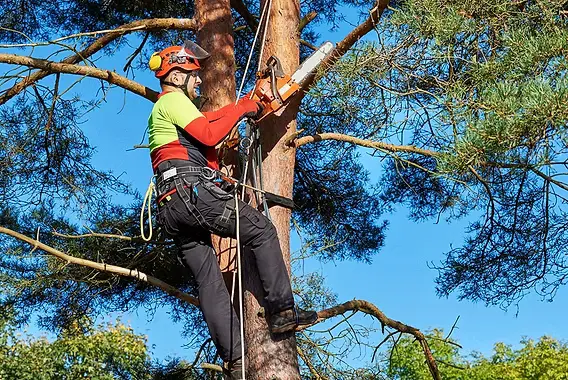
Tree service insurance costs $4,000 to $12,000 per year for small operations and $20,000 to $45,000 for crews with multiple trucks and employees. Workers’ compensation is the single largest line item, averaging $7 to $15 per $100 of payroll under NCCI class code 0106. General liability runs $130 to $150 per month for $1 million in coverage. Commercial auto adds $150 to $220 per month per vehicle.
But these averages hide a wide range. A solo arborist doing residential pruning from the ground might pay $40 per month. A four-person crew running bucket trucks and doing crane-assisted removals near commercial properties can pay $3,000 per month or more. The gap is tenfold — and the variables that drive it matter more than the average.
This guide breaks down what tree service insurance actually costs in 2026 by coverage type, operation size, and risk profile — with the exact factors that move premiums up or down. If you’re shopping coverage or trying to understand a quote you’ve already received, this is the reference you need.
What Tree Service Insurance Costs in 2026 (Quick Reference)
Here’s the at-a-glance breakdown for typical tree service operations in 2026:
| Coverage Type | Monthly Cost | Annual Cost | Notes |
|---|---|---|---|
| General Liability ($1M/$2M) | $130–$150 | $1,500–$1,800 | Higher in E&S markets |
| Workers’ Compensation | $180–$220 | $2,200–$2,700 | Per crew member; varies by state |
| Commercial Auto (per vehicle) | $150–$220 | $1,800–$2,640 | Bucket trucks cost more |
| Inland Marine (Equipment) | $50–$80 | $600–$1,000 | Scales with equipment value |
| Professional Liability (E&O) | $65–$125 | $800–$1,500 | If providing tree assessments |
| Umbrella/Excess Liability | $40–$210 | $500–$2,500 | Per $1M of additional coverage |
| Total Annual (Solo Operator) | — | $4,000–$10,000 | Single truck, no employees |
| Total Annual (Small Crew) | — | $15,000–$35,000 | 2–4 employees, basic equipment |
| Total Annual (Mid-Size Operation) | — | $35,000–$80,000 | Multiple crews, bucket trucks |
| Total Annual (Large Operation) | — | $80,000–$200,000+ | Crane work, line clearance, large fleet |
Sources: Insureon, MoneyGeek, ArboStar, Insurance Canopy, and Insuranceopedia 2026 industry analyses.
Bottom line for budgeting: if you’re a small-to-mid tree service operation in 2026, plan for $15,000–$35,000 annually in total insurance spend. Solo operators run lower; larger operations with cranes or utility line clearance work run substantially higher.
Why Tree Service Insurance Costs More Than Other Trades
Tree service is one of the deadliest trades in the United States. According to Bureau of Labor Statistics data, tree workers face a fatality rate of approximately 110 per 100,000 workers — roughly 30 times the national average across all occupations. The Tree Care Industry Association tracked 243 tree care fatalities over four calendar years (2020–2023), averaging about 61 deaths per year, with falls and contact with objects/equipment accounting for roughly 70% of those deaths.
Insurance carriers price for this risk profile in three specific ways:
1. Workers’ compensation class code 0106 carries some of the highest rates in any trade. NCCI class code 0106 — Tree Pruning, Spraying, Repairing — is the workers’ comp classification for arborist work. Rates range from approximately $7.63 per $100 of payroll in Connecticut to over $20 per $100 in higher-cost states. For comparison, an office clerk’s class code (8810) typically runs under $0.30 per $100 of payroll. The difference reflects the catastrophic injury frequency in tree work.
2. Standard carriers often decline tree service business entirely. Many general carriers won’t write tree removal operations because the claim severity profile doesn’t fit their underwriting models. This pushes coverage into the Excess & Surplus (E&S) lines market, where premiums are higher and underwriting is stricter.
3. Specific exposures (climbing, aerial work, crane operations) require explicit policy endorsements. A “tree service” policy that doesn’t specifically endorse these operations may deny claims arising from them. This is why operators who buy from generalist agents often discover coverage gaps at claim time.
Tree Service Insurance Cost by Coverage Type
General Liability Insurance Cost
General liability insurance for a tree service business costs $130 to $150 per month, or $1,500 to $1,800 per year, for $1 million per occurrence / $2 million aggregate coverage. Premiums vary by state, operation size, and whether the policy is written in the standard market or the Excess & Surplus (E&S) market.
General liability covers third-party bodily injury and property damage claims — the most common claim category for tree service contractors.
What drives general liability cost up:
- Crew size — more workers means more claim potential
- Crane operations — many policies exclude crane work without specific endorsement
- Commercial contracts — municipal, utility, and federal contracts often require $2M–$5M limits
- Claims history — even one $50,000+ claim can increase premiums 30–60% for years
- State — California averages $145/month vs. $131 national average
What lowers general liability cost:
- ISA certification and documented safety programs
- Clean three-year claims history
- Higher deductibles (raising from $1,000 to $5,000 typically saves 12–18%)
- Bundling with workers’ comp and commercial auto (saves 19–27%)
- Annual payment vs. monthly installments (saves 6–12%)
Tree removal operations specifically tend to require higher GL limits than trimming-only operations because the catastrophic-claim potential is greater.
Workers’ Compensation Insurance Cost
Workers’ compensation insurance for tree service operations costs $7 to $15 per $100 of payroll under NCCI class code 0106. A crew with $200,000 of annual payroll typically pays $14,000 to $30,000 per year for workers’ comp alone — making it the single largest line item in most tree service insurance budgets.
Workers’ compensation is required by law in 47 states for any tree service operation with employees (Texas is the only state where workers’ comp is voluntary, though most contractors carry it anyway because of the catastrophic personal liability exposure).
Workers’ comp rate factors:
- State — Connecticut runs about $7.63 per $100 of payroll for class code 0106; high-cost states push past $20 per $100
- Experience modification rate (EMR) — your three-year claims history relative to industry average; a 0.85 EMR pays 15% less than industry baseline, while a 1.25 EMR pays 25% more
- Payroll classification — split-payroll between class code 0106 (above-ground work) and class code 0042 (ground-only landscape work) can reduce premiums when applied correctly
- Crew composition — climbers and bucket truck operators carry higher exposure than ground crew
Commercial Auto Insurance Cost
Commercial auto insurance for tree service businesses costs $150 to $220 per month per vehicle, or $1,800 to $2,640 per year per vehicle. Bucket trucks insure higher than chip trucks because of the hydraulic boom value and rollover risk — typical bucket truck premiums run $2,500 to $5,000 annually per vehicle.
Commercial auto covers your trucks, trailers, chippers, stump grinders, and any vehicle used for business purposes.
Cost variables:
- Vehicle type — bucket trucks > chip trucks > pickup trucks > trailers
- Driver records — one DUI on a driver record can disqualify the operation from many carriers
- Garaging location — urban areas pay more than rural
- Mileage — operations doing emergency storm response across state lines pay more
- Hired/non-owned auto — needed when employees use personal vehicles for work; typically $50–$100/month additional
Inland Marine (Equipment) Insurance Cost
Inland marine insurance for tree service equipment costs $50 to $80 per month, or $600 to $1,000 per year, for typical equipment fleets. This coverage protects chainsaws, chippers, stump grinders, climbing gear, rigging equipment, and bucket truck attachments while in transit, on job sites, or stored off-premises.
Inland marine is critical because standard property insurance typically stops at your shop door. A stolen $35,000 stump grinder or a damaged $80,000 bucket truck attachment can be a business-ending loss without proper inland marine coverage.
Equipment value scaling:
- Solo operator ($10,000–$20,000 of equipment): $400–$700/year
- Small crew ($30,000–$80,000 of equipment): $700–$1,500/year
- Mid-size operation ($100,000–$300,000 of equipment): $1,500–$3,500/year
- Large operation with cranes ($500,000+ of equipment): $3,500–$8,000+/year
Professional Liability (E&O) Insurance Cost
Professional liability insurance (also called Errors & Omissions or E&O) for tree service operations costs $65 to $125 per month, or $800 to $1,500 per year. This coverage handles claims arising from professional advice — most commonly improper pruning claims or tree assessments that allegedly led to property damage.
This coverage is particularly important for tree trimming and pruning operations because the “improper pruning damaged my tree” claim category is unique to trimming and isn’t covered by general liability.
Umbrella / Excess Liability Insurance Cost
Umbrella liability insurance for tree service businesses costs $40 to $210 per month, or $500 to $2,500 per year, for $1 million of additional coverage above your primary limits. Premiums scale roughly linearly with additional limits — $5M umbrella typically runs 4–5x the cost of $1M umbrella.
Umbrella coverage becomes essentially mandatory once your operation pursues commercial contracts. Municipal contracts often require $2M–$5M umbrella, utility line clearance contracts require $5M–$10M, and federal facility work requires specific certificate language including additional insured status, primary/non-contributory wording, and waivers of subrogation.
Pesticide & Pollution Liability Cost
Pesticide and pollution liability insurance costs $35 to $75 per month, or $400 to $900 per year, for tree service operations that include plant health care work, herbicide treatments, or hydraulic fluid spill exposure.
Pesticide and pollution liability is often excluded from standard general liability policies. Operations doing any spray work, soil injections, or systemic plant treatments need this endorsement specifically.
Tree Service Insurance Cost by Operation Size
Solo Operator Cost ($4,000–$10,000/year)
A solo arborist with a single truck, no employees, doing residential trimming and small removals typically pays:
- General liability: $40–$125/month
- Commercial auto: $150–$200/month
- Inland marine: $35–$60/month
- Professional liability (optional): $65–$95/month
- Umbrella (optional): $40–$60/month for $1M
Total: roughly $4,000–$10,000 annually depending on whether umbrella and E&O are added. Workers’ comp isn’t required when you have no employees, though some states require it even for owners under certain business structures.
Small Crew Cost ($15,000–$35,000/year)
A 2–4 person crew with one bucket truck, a chipper, and basic equipment doing residential and light commercial work typically pays:
- General liability: $130–$200/month
- Workers’ compensation: $200–$1,500/month (depends heavily on payroll and state)
- Commercial auto: $300–$500/month for 2 vehicles
- Inland marine: $60–$100/month
- Professional liability: $65–$125/month
- Umbrella: $50–$100/month for $1M–$2M
Total: roughly $15,000–$35,000 annually. Workers’ comp dominates the line item budget at this scale.
Mid-Size Operation Cost ($35,000–$80,000/year)
A 5–15 person operation with multiple bucket trucks, possibly a small crane, doing significant commercial work typically pays:
- General liability: $200–$400/month with $2M–$5M limits
- Workers’ compensation: $1,500–$5,000/month
- Commercial auto: $600–$1,500/month for fleet
- Inland marine: $150–$300/month
- Professional liability: $125–$250/month
- Umbrella: $200–$500/month for $5M
- Pollution liability: $50–$100/month if doing PHC work
Total: roughly $35,000–$80,000 annually. Bundle discounts and a clean EMR matter substantially at this scale.
Large Operation Cost ($80,000–$200,000+/year)
Operations running multiple crews, full crane operations, utility line clearance, or municipal/federal contracts typically pay:
- General liability: $500–$1,500/month with $5M+ limits
- Workers’ compensation: $5,000–$15,000+/month
- Commercial auto: $1,500–$3,500/month for fleet
- Inland marine: $400–$800/month
- Professional liability: $250–$500/month
- Umbrella: $500–$2,000/month for $10M+
- Pollution liability: $100–$300/month
Total: $80,000–$200,000+ annually. Operations doing utility line clearance with EHAP-certified crews can push significantly higher.
What Drives Tree Service Insurance Premiums Up or Down
Five factors drive 80% of premium variation between similar tree service operations:
1. Type of Tree Work Performed
This is the single biggest cost variable. From lowest to highest risk:
- Ground-level pruning and shrub work (lowest premium)
- Residential trimming with bucket truck
- Climbing operations
- Tree removal
- Crane-assisted removals
- Utility line clearance
- Emergency storm response (highest premium)
Operations doing utility line clearance pay roughly 3–5x what residential trimming operations pay for equivalent payroll volume.
2. Crew Size and Payroll
Workers’ comp scales linearly with payroll. Doubling crew size doubles workers’ comp premium. General liability scales partially with crew size — additional climbers and ground crew add exposure but not at the same rate as payroll itself.
3. Equipment Value and Vehicle Fleet
Each bucket truck adds $2,500–$5,000/year to commercial auto premium. Each $50,000 piece of equipment adds $400–$800 to inland marine.
4. Claims History and Experience Modification Rate (EMR)
EMR is the most important factor most operators don’t fully understand. It’s a multiplier applied to your workers’ comp base premium based on your three-year claims history relative to industry average:
- 0.85 EMR: 15% premium discount (industry-leading safety record)
- 1.00 EMR: Industry average (baseline)
- 1.15 EMR: 15% premium increase (one or two moderate claims)
- 1.50 EMR: 50% premium increase (significant claims pattern)
A clean three-year claims record can save tens of thousands in workers’ comp premium over the life of an operation.
5. Geographic Market
State workers’ comp rates vary 3–4x for class code 0106. Operations in Florida, Texas, and California pay more than operations in lower-rate states. Your state’s specific market dynamics matter substantially.
How to Reduce Tree Service Insurance Costs
Five strategies that actually move premium:
1. Bundle Policies Through One Carrier
Combining general liability, workers’ comp, commercial auto, and inland marine through a single carrier or carrier group typically saves 19–27% versus buying each policy separately. Independent agents who shop multiple carriers can structure bundles strategically.
2. Improve Your EMR
Document safety programs. Get ISA-certified arborists on staff. Implement ANSI Z133 safety standards compliance documentation. Reduce reportable injuries through training and PPE enforcement. EMR improvements compound over three years.
3. Raise Equipment and Auto Deductibles
Raising auto and inland marine deductibles from $1,000 to $5,000 typically saves 12–18%. Keep general liability deductibles low — claim severity in GL can be six figures, and a $5,000 deductible doesn’t change the claim mechanics meaningfully.
4. Pay Annually Instead of Monthly
Monthly installment plans add 6–12% in processing fees. On a $30,000 annual premium, that’s $1,800–$3,600 in pure fee savings.
5. Use a Specialty Agent, Not a Generalist
This is the strategic move that matters most. A generalist agent will write your tree service policy through whatever standard carrier they have access to — which often means coverage gaps and higher premiums than necessary. A specialty tree service insurance agent with access to carriers like Amerisafe, West Bend, and others that specifically write tree care can structure programs that pass contract requirements without overspending.
Frequently Asked Questions
How much does tree service insurance cost in 2026?
Tree service insurance costs $4,000 to $12,000 annually for most small operations and $20,000 to $45,000 for crews with multiple trucks and employees. Workers’ compensation is the largest line item, averaging $7 to $15 per $100 of payroll under NCCI class code 0106.
What is the cheapest insurance for a tree service business?
General liability insurance is the cheapest single policy at $130 to $150 per month for $1 million in coverage. However, most tree service operations also need workers’ compensation, commercial auto, and inland marine to be properly protected — bundling these typically saves 19 to 27 percent versus buying separately.
Why is tree service insurance so expensive?
Tree service is one of the deadliest trades in the United States, with a fatality rate of approximately 110 per 100,000 workers — roughly 30 times the national average. Insurance carriers price for this catastrophic injury risk, particularly through workers’ compensation class code 0106, which carries some of the highest rates in any trade.
How much does workers’ comp cost for tree services?
Workers’ compensation costs $7 to $15 per $100 of payroll for tree service operations under NCCI class code 0106. A crew with $200,000 of annual payroll typically pays $14,000 to $30,000 per year, with rates varying significantly by state.
Can I get tree service insurance with no employees?
Yes. Solo tree service operators can typically get general liability coverage starting at $40 to $125 per month for $1 million in coverage. Workers’ compensation isn’t required when you have no employees, though some states require it even for owners depending on business structure.
Get a Tree Service Insurance Quote
If you’re shopping coverage or want a second opinion on quotes you’ve already received, TreeGuard can help. We’re independent agents specializing exclusively in tree care — we shop 16+ A-rated carriers including Amerisafe, West Bend, and others that specifically write class code 0106 operations.
Most quotes come back within 1–2 hours during business hours. We work with operations from solo arborists to multi-crew operations doing utility line clearance.

More from Coverage Explained
Ready to get properly covered?
Tell us about your tree care operation and we'll compare options across our carrier network. Quote response within 1–2 hours during business hours.
Independent agency · 16+ A-rated carriers · Licensed in 48 states