
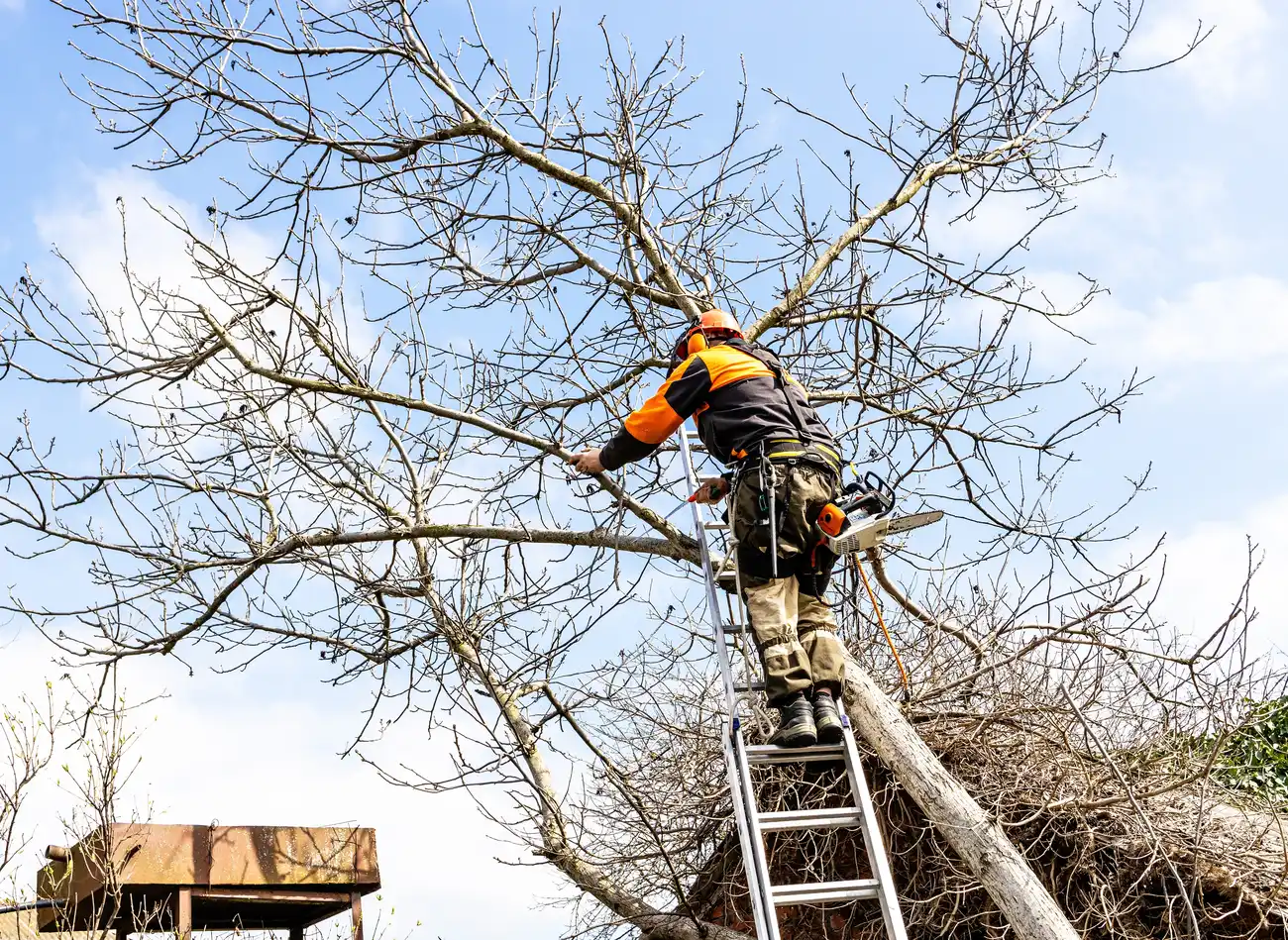
The most common growth-stage problem in tree service isn’t capacity, equipment, or even pricing — it’s getting enough good jobs to keep the crew busy and profitable. Tree service is a high-demand business in most markets, but the operations that consistently grow have systematic marketing approaches. The ones that struggle rely on word-of-mouth and hope. The difference between the two outcomes comes down to which channels you invest in, in what order, and how systematically you execute.
This guide walks through the complete tree service marketing playbook for 2026. We cover the seven highest-ROI channels (and the ones to avoid), how to build a Google Business Profile that dominates local search, the specific Local Service Ad strategy that works in 2026, the neighborhood marketing tactics that compound over time, the review generation system that drives organic traffic, and the realistic budgets and timelines for each channel. By the end, you’ll have a marketing playbook that fits your operation’s stage.
The framework is built from current 2026 industry data, real customer acquisition cost benchmarks across tree service operations, and the channel performance patterns we see across hundreds of contractor accounts. The same principles apply whether you’re a solo operator looking for your next 5 jobs or a multi-crew operation trying to fill 200 jobs per month.
The Marketing Channel Hierarchy
Most tree service operators waste 60-70% of their marketing budget by investing in low-ROI channels before maximizing high-ROI channels. The channel hierarchy that works:
Tier 1 — Always do these first (free or low-cost, highest ROI):
- Google Business Profile optimization
- Yard signs at every completed job
- Branded vehicle signage
- Customer referral program
- Review generation system
Tier 2 — Add these once Tier 1 is producing (paid, high-intent): 6. Google Local Service Ads 7. Door hangers post-storm 8. Google Search Ads (if competitive market)
Tier 3 — Consider these only after Tier 1-2 are saturated: 9. Lead generation platforms (Thumbtack, Angi, HomeAdvisor) 10. Direct mail to specific neighborhoods 11. Branded content/SEO blog 12. Nextdoor business presence
Tier 4 — Almost never worth the spend for tree service:
- Facebook/Instagram ads (low intent for service)
- TV/radio (poor targeting)
- Print directories (declining relevance)
- Generic link-building SEO services
Operations spending on Tier 3-4 before maximizing Tier 1-2 are leaving substantial revenue on the table. The exact channels in each tier matter less than the order — a fully-optimized Google Business Profile + yard signs + vehicle signage will outperform a $5,000/month Facebook campaign every time.
Google Business Profile: The Foundation Channel
If you do nothing else from this guide, optimize your Google Business Profile (GBP). It’s free, it’s the #1 driver of local tree service leads, and most competitors do it badly — which means a properly optimized profile dominates immediately.
Why Google Business Profile matters most:
- 76% of people who search for a local service visit a business within 24 hours (Google data)
- 60-80% of organic local leads come through Google Business Profile (not your website)
- Reviews on GBP drive both ranking and conversion
- Photo content drives engagement and category authority
- Profile completeness directly affects ranking
The complete GBP optimization checklist:
Phase 1 — Foundation (1-2 hours):
- Claim and verify your profile
- Set primary category as “Tree Service” (not “Landscaper” — this is the most common mistake)
- Add secondary categories: “Arborist Service,” “Tree Removal Service,” “Stump Removal Service”
- Complete business name exactly as it appears on your truck and website (NAP consistency)
- Add full physical address (or service area if you don’t have a public-facing location)
- Add phone number (use call tracking number for marketing attribution if possible)
- Add website URL
- Set business hours including emergency availability
- Add detailed business description (use words like “tree removal,” “tree trimming,” “stump grinding,” “certified arborist,” “emergency tree service”)
Phase 2 — Content depth (ongoing):
- Upload 25+ photos of completed jobs, equipment, crew (not stock images)
- Update photos weekly with new job completions
- Create Posts (similar to social media) at least every 7 days about completed work, seasonal tips, storm response
- Add product/service listings for each major service type with pricing ranges
- Add Q&A entries answering common customer questions
- Verify and respond to all reviews within 48 hours
Phase 3 — Authority building (months 2-12):
- Request reviews from every customer within 48 hours of job completion
- Target 50+ reviews with 4.5+ star average
- Add detailed responses to reviews (including negative ones — handled professionally)
- Build out service area descriptions for each city/neighborhood you serve
- Add booking links for online quote requests
A fully-optimized GBP typically produces 30-80 leads per month for established operations in mid-sized markets, completely free. This is the highest-ROI channel in tree service marketing.
The Yard Sign Strategy
Yard signs at completed jobs are arguably the second-highest ROI marketing investment after Google Business Profile, yet most operations underuse them. Here’s why they work and how to maximize them.
Why yard signs convert at 5-10x cold leads:
- Neighbors see active work happening — proves you do tree work in their area
- The completed job result is visible — proves quality
- Word-of-mouth between neighbors is built-in marketing
- Trust transfers from neighbor to your business
- Timing is perfect — neighbors with similar tree concerns notice immediately
The yard sign system that maximizes results:
Sign design and placement:
- 18” × 24” professional sign with tree service branding
- Phone number and website (no email — phones convert better)
- “Free Estimates” or “Licensed & Insured” tagline
- Place at the front of the property at the completion of every job
- Get explicit homeowner permission to leave signs for 5-7 days
Sign deployment frequency:
- Every completed residential job in target neighborhoods
- Multiple signs at corner lots for double visibility
- Concentrate signs in the neighborhoods you most want to serve
- After storms, deploy signs aggressively in damaged neighborhoods
Cost-benefit math:
- Sign cost: $15-$25 per sign (durable, multi-use)
- 100 signs purchased = $1,500-$2,500
- Reusable for 12-24 months
- Average 1-2 jobs generated per sign-week of placement
- Cost per job typically $20-$40 (vs. $150-$400 for paid acquisition)
A yard sign at every completed job is the simplest, most consistently-effective marketing tactic in tree service. The 5-mile rule applies: signs in neighborhoods within 5 miles of your concentrated work area produce dramatically better results than signs in scattered locations.
Vehicle Signage: The Mobile Billboard
Branded vehicle signage transforms your truck into a 24/7 mobile advertisement. According to Outdoor Advertising Association of America data, vehicle wraps generate 30,000-70,000 daily impressions per fully wrapped vehicle in suburban markets.
Investment levels and ROI:
Magnetic signs ($50-$150 per set):
- Cheapest entry point
- Removable when needed
- Lower visual impact than wraps
- Best for new operations testing branding
- Lifespan: 6-18 months before fading/losing magnetic strength
Vinyl decals ($300-$1,200):
- Permanent application
- Significantly better visual quality than magnetics
- Cover doors, tailgate, side panels
- Lifespan: 5-7 years
- Best ROI for most established operations
Full vehicle wrap ($2,500-$8,000):
- Highest visual impact and brand recognition
- Cover entire truck exterior
- Includes truck body, hood, tailgate, sometimes windows
- Lifespan: 5-10 years
- Best for operations doing significant marketing volume
Required design elements:
- Business name (large, readable from 50+ feet)
- Phone number (large, readable from moving traffic)
- Website (smaller, less critical)
- 1-2 services listed (“Tree Removal,” “Stump Grinding”)
- “Licensed & Insured” badge
- Optional: ISA Certified Arborist badge if applicable
The break-even calculation is straightforward: a $1,500 vinyl decal investment pays for itself with one customer call ($1,500 average ticket size). Most operations report 5-15 leads per month from vehicle signage alone in suburban markets.
Customer Referral Program
Referrals are the highest-conversion marketing channel: prospects who arrive via referral close at 50-70% rates compared to 20-35% for cold leads. A systematic referral program multiplies this naturally-occurring channel.
The 3-tier referral structure:
Tier 1 — Customer-to-customer referrals:
- $25-$100 cash or gift card to existing customers who refer new business
- Awarded after the referred customer’s job is completed and paid
- Tracked in CRM by referral source field
- Communicated via post-job email and yard sign
- Typically produces 10-25% of leads for established operations
Tier 2 — Professional referral network:
- Real estate agents, property managers, landscapers, arborists
- $100-$300 referral fee for jobs over $1,000
- Quarterly check-ins to maintain relationships
- Branded materials (business cards, brochures) provided to referral partners
- Best for operations targeting commercial work
Tier 3 — Strategic partnerships:
- Insurance adjusters (property damage tree work)
- Home inspectors (tree health assessments)
- HVAC and roofing contractors (often see tree concerns at customer properties)
- Reciprocal referral relationships
- Best for operations with established reputation
Implementation steps:
- Add referral source field to your CRM/intake form
- Create a simple thank-you process (post-job email mentioning referral program)
- Print referral cards customers can hand to neighbors
- Track referral attribution monthly
- Pay incentives within 30 days of referred job completion
A well-run referral program in established operations produces 20-40% of total job volume — entirely from existing customer relationships.
Review Generation System
Reviews are the foundation of digital trust. Operations with 50+ reviews and 4.5+ star averages dominate Google rankings, command premium pricing, and convert leads at higher rates. Here’s how to build the review generation system that drives this.
The systematic review request flow:
Step 1 — Set expectations during the estimate:
“After we complete the work, we’ll send a follow-up requesting a review. Customer feedback helps us improve and helps neighbors find us. Could we count on you for that?”
This pre-commits the customer to leave a review and dramatically increases response rates.
Step 2 — Request immediately after job completion:
- Send text message within 2-4 hours of completion
- Include direct link to Google review form
- Keep message short and personal
- Sample: “Thanks for choosing [Business Name]! It was great working with you. If you have a moment, would you mind leaving a review at [direct Google review link]? It really helps us. — [Owner Name]”
Step 3 — Follow up at 7 days for non-responders:
- Second touch via email
- More detailed message with specific job mentions
- Include 2-3 photos of the completed work
- Direct review link
Step 4 — Respond to every review within 48 hours:
- Thank the customer specifically (mention something about the job)
- For negative reviews: respond professionally, offer to resolve the issue
- For 5-star reviews: thank them and mention you appreciate them sharing with their neighbors
Realistic response rates:
- Without a system: 5-10% of customers leave reviews
- Basic text request: 20-30% leave reviews
- Full systematic flow with pre-commitment: 35-55% leave reviews
For an operation completing 100 jobs per year, the systematic flow produces 35-55 reviews annually — enough to build a competitive Google presence in 12-18 months.
Google Local Service Ads
Once your Google Business Profile is optimized and you have 10-15+ reviews, Google Local Service Ads (LSA) become the highest-leverage paid acquisition channel.
How Local Service Ads work:
- Display at the very top of Google search results, above standard ads
- Show “Google Guaranteed” badge for verified businesses
- Charge per lead (phone calls or messages), not per click
- Google pre-qualifies leads based on customer search intent
- Available in most U.S. markets in 2026
Why LSA outperforms standard Google Ads for tree service:
- Higher visual position drives 30-40% click-through rates
- Pre-qualification reduces tire-kicker leads
- Google Guaranteed badge increases conversion
- Pay-per-lead structure aligns with sales-driven tree service economics
- Customer reviews from Google Business Profile carry directly to LSA
Cost benchmarks for tree service Local Service Ads in 2026:
| Market Size | Cost Per Lead | Close Rate | Effective CAC |
|---|---|---|---|
| Small/rural | $30-$50 | 30-45% | $75-$120 |
| Suburban | $40-$80 | 25-40% | $120-$250 |
| Major metro | $60-$120 | 20-35% | $180-$450 |
Recommended budget tiers:
- New users: $500-$1,000/month, focus on close rate optimization
- Established operations: $1,500-$5,000/month for steady job flow
- Growth operations: $5,000-$15,000+/month for aggressive expansion
Common LSA mistakes:
- Insufficient Google Business Profile reviews (under 15) before launching
- Poor lead response time (must respond within 5 minutes for best results)
- Not disputing junk leads (Google credits valid disputes)
- Bidding outside primary service area (low close rates)
- Not tracking close rates by lead source within LSA
Operations using LSA effectively typically achieve 20-40% of total leads from this single channel.
Door Hangers and Storm Response Marketing
Door hangers might seem old-school, but they’re one of the highest-ROI marketing tactics for tree service — particularly in storm response situations.
Why door hangers work for tree service:
- Highly targeted to specific neighborhoods
- Tangible — homeowners physically hold the marketing piece
- Perfect timing when neighborhoods have visible tree damage
- Low cost per impression
- Drives immediate phone calls when properly timed
The standard door hanger strategy:
- 1,000 hangers for $300-$500 (printing + simple distribution)
- Distribute in neighborhoods near completed jobs
- Include phone number, website, “Licensed & Insured,” 2-3 services
- Response rate: 1-3% in normal conditions (10-30 leads per 1,000)
Storm response marketing — the highest-ROI tactic in tree service:
When weather events damage trees, the operations that respond fastest with targeted marketing capture disproportionate revenue. Here’s the storm response playbook:
Pre-storm preparation:
- Maintain 1,000-2,000 door hangers in inventory
- Pre-print specific “Storm Damage Response” hangers
- Identify high-risk neighborhoods (mature trees, storm-prone areas)
- Have a distribution plan ready (which neighborhoods first)
During and immediately post-storm:
- Monitor weather alerts for your service area
- Distribute hangers within 2-12 hours of storm damage
- Door hangers can produce 5-10% response rates in storm zones (vs. 1-3% normal)
- Combined with yard signs at active jobs, neighborhood saturation drives 30-50% of jobs in active storm response
Storm response volume potential:
- Normal weeks: 5-15 jobs per week for established operations
- Active storm response: 30-100+ jobs per week possible
- Storm response premium pricing: 50-100% above standard rates
- Storm work can generate 20-40% of annual revenue in 1-2 active weeks
Operations that systematize storm response (pre-printed hangers, distribution routes, premium pricing) capture revenue that scattered competitors miss.
Cost Per Lead by Channel
Understanding the relative cost-effectiveness of each channel helps allocate marketing spend optimally. Here’s the realistic 2026 cost per lead by channel:
| Channel | Cost Per Lead | Close Rate | Effective CAC |
|---|---|---|---|
| Google Business Profile (organic) | $0 | 25-35% | $0 |
| Yard signs | $5-$15 | 35-50% | $15-$40 |
| Vehicle signage | $10-$30 | 25-40% | $30-$120 |
| Customer referrals | $25-$100 | 50-70% | $50-$200 |
| Google Local Service Ads | $30-$120 | 25-40% | $90-$450 |
| Door hangers | $20-$50 | 15-30% | $80-$300 |
| Direct mail | $40-$80 | 10-25% | $200-$700 |
| Google Search Ads | $50-$150 | 15-25% | $300-$900 |
| Thumbtack/Angi/HomeAdvisor | $25-$80 | 8-20% | $200-$800 |
| Facebook Ads | $40-$120 | 5-15% | $400-$2,000 |
| Nextdoor | $30-$80 | 15-30% | $130-$500 |
Key insight: Tier 1 free and low-cost channels (Google Business Profile, yard signs, vehicle signage) consistently produce the lowest customer acquisition costs. Most operations should invest 60-70% of marketing time in these channels before scaling paid acquisition.
For deeper context on how customer acquisition cost connects to your pricing structure, see our tree service pricing guide.
The 30-60-90 Day Marketing Launch Plan
For operators starting marketing from scratch or relaunching after stagnation, here’s the proven 90-day execution plan:
Days 1-30: Foundation (free/low-cost)
- Week 1: Claim and fully optimize Google Business Profile
- Week 2: Set up review request system, request reviews from last 20 customers
- Week 3: Order yard signs, vehicle signage, business cards
- Week 4: Launch referral program, communicate to existing customers
Expected results: 5-15% lead increase, foundation for compounding growth
Days 31-60: Paid acquisition launch
- Week 5: Launch Google Local Service Ads at $1,000-$2,000 monthly
- Week 6: Print door hangers, identify target neighborhoods
- Week 7: Launch Google Search Ads if LSA performance is strong
- Week 8: Optimize all paid campaigns based on initial performance
Expected results: 20-40% lead increase, predictable paid acquisition channel
Days 61-90: Optimization and scaling
- Week 9: Analyze close rates by lead source, double down on highest-ROI channels
- Week 10: Scale highest-performing channels (typically LSA + Google Business Profile)
- Week 11: Add Tier 3 channels if Tier 1-2 are saturated
- Week 12: Establish ongoing review request system, monthly photo updates, quarterly campaign review
Expected results: 50-100% lead increase from baseline, sustainable systems for ongoing growth
This 30-60-90 day pattern has been validated across hundreds of tree service operations. The key is sequencing — Tier 1 channels first, paid second, advanced channels third. Skipping the order means wasting spend on channels that haven’t been properly set up to convert.
Marketing Budget Benchmarks by Operation Stage
How much should you actually spend on marketing? Here are the realistic 2026 benchmarks:
Bootstrap operations ($0-$150K revenue):
- Marketing budget: $1,000-$3,000 annually
- Focus: 100% Tier 1 (Google Business Profile, yard signs, vehicle signage, referrals)
- Avoid: Paid acquisition until pricing supports it
Standard operations ($150K-$400K revenue):
- Marketing budget: $5,000-$25,000 annually (3-7% of revenue)
- Focus: Tier 1 + Google Local Service Ads
- Add: Door hangers in storm response
Growth operations ($400K-$1M revenue):
- Marketing budget: $25,000-$80,000 annually (5-10% of revenue)
- Focus: All Tier 1-2 channels at scale
- Add: Direct mail, Google Search Ads, content marketing
Mature operations ($1M+ revenue):
- Marketing budget: $50,000-$300,000+ annually (5-10% of revenue)
- Focus: Multi-channel attribution and optimization
- Add: Marketing automation, dedicated marketing role/agency
Operations spending less than 3% of revenue on marketing typically stagnate. Operations spending more than 15% are usually being inefficient — the answer is better targeting, not more spend.
What to Avoid: Low-ROI Channels for Tree Service
Several marketing channels consistently underperform for tree service operations. Avoid these unless you have specific reasons:
Facebook and Instagram ads:
- Low search intent (people aren’t actively looking for tree service when scrolling)
- Tree service is event-driven (storm damage, seasonal pruning) which doesn’t match social media advertising patterns
- Cost per qualified lead typically $200-$500+
- Better used for brand awareness in mature markets only
Lead generation platforms (Thumbtack, Angi, HomeAdvisor):
- Leads sold to multiple competitors simultaneously
- 8-20% close rates (much lower than other channels)
- Customers expect lowest-bidder pricing
- Quality variability — many tire-kickers and price shoppers
- Use only as supplementary channel, never as primary
Print directories and Yellow Pages:
- Declining usage
- Poor measurability
- High cost relative to ROI
- Demographic skews older
TV and radio advertising:
- Geographic targeting too broad for local service businesses
- High production and placement costs
- Difficult to measure ROI
- Only justified at $5M+ revenue scale
Generic SEO link-building services:
- Often produce penalty-grade backlinks
- Can damage Google rankings
- Better to invest in content marketing and Google Business Profile
Sponsorships of unrelated events:
- Brand exposure without conversion mechanism
- Difficult to measure
- Best reserved for community goodwill, not lead generation
Tracking and Attribution
The marketing operations that scale fastest are those that track which channels actually produce profitable jobs. Here’s the basic attribution system:
Required tracking elements:
Lead source field in CRM:
- Add a required field on every new customer record
- Standardized options: Google Business Profile, Yard Sign, Vehicle, Referral (specify), Local Service Ad, Door Hanger, Search Ad, Other
- Train all customer-facing staff to ask “How did you hear about us?”
Phone tracking numbers:
- Use unique phone numbers for each major channel where possible
- Vehicle signage gets one number, yard signs another, etc.
- Tools like CallRail ($45-$150/month) handle this automatically
- Critical for paid acquisition ROI calculation
Monthly performance review:
- Track leads, jobs closed, revenue, and CAC by channel
- Compare against target benchmarks
- Reallocate spend toward highest-ROI channels
- Drop or reduce underperforming channels
Annual marketing planning:
- Review full year by channel
- Identify trends and seasonal patterns
- Plan storm response inventory for next year
- Adjust budget allocation based on ROI
Operations that don’t track marketing performance typically waste 30-50% of their spend on underperforming channels. Even basic monthly tracking can improve marketing ROI by 50-100%.
Frequently Asked Questions
How much should a tree service business spend on marketing?
Tree service operations should spend 5-10% of revenue on marketing during steady-state operations and 10-15% during growth phases. A $300,000 operation should budget $15,000-$30,000 annually for marketing during normal operations, $30,000-$45,000 during aggressive growth phases. Bootstrap operations under $200,000 revenue should focus first on free channels (Google Business Profile, yard signs, referrals) before paid acquisition. Operations spending less than 3% on marketing typically stagnate. Operations spending more than 15% are usually being inefficient — the answer is better targeting, not more spend.
What’s the best marketing channel for tree service businesses?
Google Business Profile is the highest-ROI marketing channel for tree service businesses, period. It’s free, drives 60-80% of organic local leads for well-optimized profiles, and produces compounding returns through review accumulation. After Google Business Profile, the highest-ROI channels are: yard signs at completed jobs (essentially free, 5-10x conversion vs cold leads), Google Local Service Ads ($30-$80 per lead, pre-qualified), neighborhood door hangers post-storm ($300-$500 per 1,000 distributed, 1-3% response rate), and referral programs. Most operators waste marketing spend on Facebook ads and lead generation platforms before fully optimizing the higher-ROI channels.
How long does it take for tree service marketing to generate jobs?
Marketing channel timelines vary significantly. Immediate results (within 24-48 hours): Google Local Service Ads, Google Search Ads, lead generation platforms (Thumbtack, Angi, HomeAdvisor). Short-term results (1-4 weeks): Google Business Profile activation, door hangers post-storm, branded vehicle signage. Medium-term results (1-3 months): yard sign visibility, review accumulation, referral program activation. Long-term results (3-12 months): organic SEO ranking, content marketing, neighborhood reputation building. The compounding nature of organic channels means consistent investment over 6-12 months produces dramatically better ROI than the same investment concentrated in paid acquisition.
Are Google Local Service Ads worth it for tree service?
Yes, Google Local Service Ads are worth it for most tree service operations once Google Business Profile is properly optimized and you have at least 10-15 reviews. Local Service Ads charge per lead (typically $30-$80 for tree service in 2026, varying by market) rather than per click, and Google pre-qualifies leads. The “Google Guaranteed” badge significantly increases conversion compared to standard ads. Operations typically achieve 25-40% close rates on Local Service Ad leads, making the effective customer acquisition cost reasonable. Start with $500-$2,000 monthly budgets and scale based on close rates.
How important are Google reviews for tree service businesses?
Google reviews are critically important — they directly drive ranking on Google Business Profile, conversion rates on Local Service Ads, and customer trust in the buying decision. Operations with 50+ reviews and 4.5+ star averages typically rank top-3 in local Google results, which captures 60-80% of organic local searches. Operations with under 25 reviews struggle to compete regardless of other marketing investment. Build a systematic review generation system that requests reviews from every customer within 24-48 hours of job completion. Aim for 30-50% of customers leaving reviews, which produces 8-15 reviews per 50 jobs at typical response rates.
What marketing channels should I avoid as a new tree service operator?
Several marketing channels consistently produce poor ROI for tree service operations and should be deprioritized: Facebook ads (low intent, expensive cost per qualified lead), Instagram ads (very low conversion for service businesses), TV and radio (expensive with poor targeting), generic SEO link-building services (often produce penalty-grade backlinks), Yellow Pages and traditional print directories (declining relevance, expensive), and sponsorships of unrelated community events. Focus marketing investment on high-intent channels where customers are actively searching for tree service. Brand-building marketing only makes sense after high-intent channels are saturated.
How do I generate tree service leads without paid advertising?
Tree service operations can generate consistent leads through free channels. The four highest-ROI free channels: 1) Google Business Profile optimization with weekly photo posts and consistent review requests (drives the most organic local leads), 2) Yard signs at every completed job (5-10x higher conversion than cold leads, $200-$500 one-time investment), 3) Branded vehicle signage (30,000-70,000 daily impressions per fully wrapped truck per Outdoor Advertising Association data), 4) Customer referral programs ($25-$100 incentives for successful referrals produce 15-30% of jobs for established operations). Combined, these channels can generate 60-80% of leads for established operations without ongoing advertising spend.
Build the Marketing Foundation Before You Need It
The tree service operations that grow consistently aren’t necessarily the ones spending the most on marketing — they’re the ones with systematic foundations that compound over time. A fully-optimized Google Business Profile takes 2-3 hours to set up and produces leads for years. A yard sign protocol takes one decision and produces leads at every completed job. A review request system takes 30 minutes to set up and drives ranking and conversion for the life of the business.
TreeGuard works with growing tree service operations to ensure that the insurance side of the business is structured to support marketing growth. As your operation scales, contract requirements increase — commercial customers need Certificates of Insurance, municipal contracts require higher liability limits, and equipment growth requires updated inland marine coverage. Marketing growth without coordinated insurance growth creates contract opportunities you can’t actually fulfill.
For deeper resources on growing your tree service operation, our complete content library includes: the tree service pricing guide covering rate calculation that supports marketing investment, the hiring guide covering when growing demand should trigger hiring, the tree service business plan template for structuring marketing as part of comprehensive business strategy, the tree service insurance cost guide with state-by-state breakdowns, and the Certificate of Insurance guide for navigating commercial contracts that marketing produces.
External resources for further reference: Google Local Service Ads for the official LSA platform documentation, Google Business Profile for profile management, Outdoor Advertising Association of America for vehicle wrap impression data, Bureau of Labor Statistics for tree workers safety data that affects insurance and marketing positioning, and Tree Care Industry Association for industry resources and accreditation that strengthens marketing credibility.

More from Running & Growing Your Business

Ready to get properly covered?
Tell us about your tree care operation and we'll compare options across our carrier network. Quote response within 1–2 hours during business hours.
Independent agency · 16+ A-rated carriers · Licensed in 48 states