
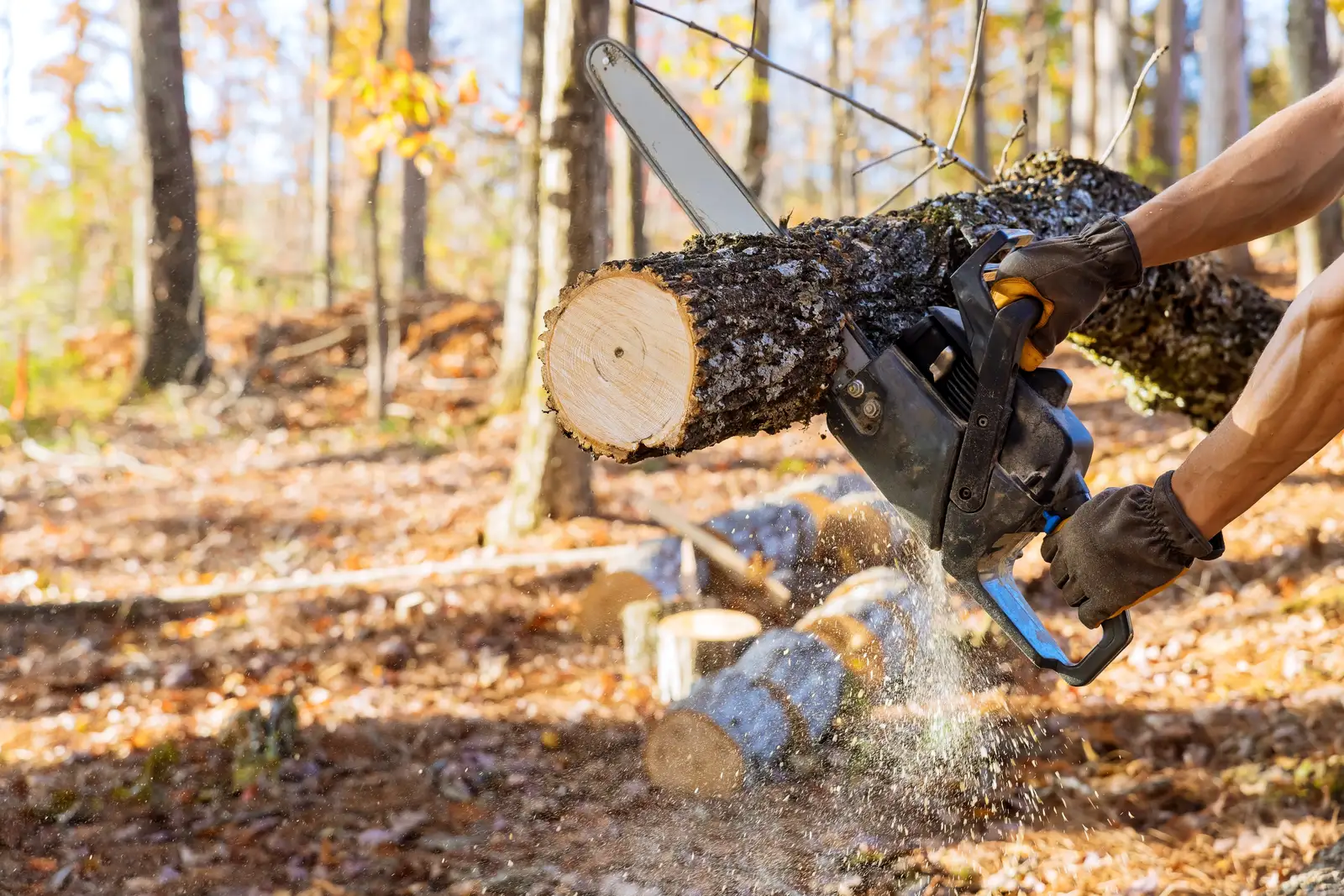
West Virginia is the most mountainous state east of the Mississippi and one of the most heavily forested, and the combination produces a tree care market shaped more by terrain than by canopy. Mature Appalachian hardwood — oak, hickory, maple, tulip poplar, black cherry — stands on slopes above narrow valley towns, along hollow roads, and over the long distribution circuits that carry power to a population spread thin across difficult ground.
Two regulatory facts define the insurance picture, and both are commonly reported wrong. The workers’ compensation market here has been fully competitive since 2008, though guidance still lists West Virginia among the monopolistic states. And the contractor licensing scheme moved statute chapters entirely in 2021, so most published citations point at repealed law. This page covers both from the current code, what a West Virginia program costs, and what steep ground does to the work.
What Tree Service Insurance Costs in West Virginia
West Virginia is a competitive market on every line. That is a relatively recent condition for the compensation line and it is the single most useful fact about pricing here — the number is shoppable.
The ranges below reflect what most West Virginia tree service contractors typically pay:
- General Liability Insurance: $850–$2,500 per year for a typical West Virginia small operation. The Eastern Panhandle around Martinsburg, where property values track the Washington commuter market, runs at the top of the range.
- Workers’ Compensation: $7–$13 per $100 of payroll on class code 0106. A worked example: a crew with $200,000 of payroll typically pays $14,000–$26,000 annually — a figure that was not open to competition before 2008 and is now.
- Commercial Auto Insurance: $1,900–$3,900 per truck per year, driven by mountain grade, narrow secondary roads and winter conditions rather than by traffic density.
- Inland Marine (Equipment) Insurance: $400–$1,500 per year, tracking scheduled value and how often equipment stays on remote hollow and ridge jobs.
- Pesticide & Pollution Liability: $400–$900 per year for operations treating under Department of Agriculture certification.
- Umbrella / Excess Liability: $500–$1,300 per year for a first excess layer, routinely required by utility line clearance and municipal contracts.
The largest single variable in a West Virginia program is usually the line clearance share of the book, which prices differently from residential removal. For the rating factors that apply in every state, see the national cost guide.
Workers’ Compensation in West Virginia
West Virginia requires coverage from the first employee, and the market that supplies it is private and competitive.
W.Va. Code § 23-2C-1 is the section that records how the state got here. It states that the employers’ mutual insurance company created as the successor to the former Workers’ Compensation Commission began operation on January 1, 2006, and that the state opened to a private, competitive market for workers’ compensation insurance on July 1, 2008. The section itself notes that it remains in the code for historical purposes — the transition is complete and the statute is a record of it.
Tree work classifies under code 0106, with NCCI serving as the rating and statistical organization and the Offices of the Insurance Commissioner overseeing the market.
The exposures are the familiar ones. Seasonal and part-time crew count from day one. A subcontracted crew arriving without its own certificate is likely to be picked up as payroll at audit, at the tree work rate. And in a trade with this severity profile, the experience modifier built over three years is worth more than any single year’s shopping — which is an argument that only became true here after 2008.
Contractor Licensing Moved Chapters in 2021
This is the section where nearly every published guide to West Virginia is out of date, and the error runs in a direction that could cost an operator money.
The Old Citations Are Repealed Law
The West Virginia Contractor Licensing Act used to sit at Chapter 21, Article 11. That article was repealed in its entirety by House Bill 2006 in the 2021 regular session — §§ 21-11-1 through 21-11-20 all now return as repealed in the code. Guidance citing § 21-11, or citing a $2,500 threshold drawn from it, is citing law that no longer exists.
The licensing scheme was not abolished. It was moved. It now lives at Chapter 30, Article 42, alongside the state’s other occupational licensing boards, with the West Virginia Contractor Licensing Board continuing to administer it.
What the Current Definition Reaches
W.Va. Code § 30-42-3 defines a contractor as a person who, in any capacity for compensation other than as an employee of another, undertakes, offers to undertake, purports to have the capacity to undertake, or submits a bid to construct, alter, repair, add to, subtract from, improve, move, wreck, or demolish any building, highway, road, railroad, structure, or excavation associated with a project, development, or improvement — including the erection of scaffolding or other structures in connection with it — where the cost of the undertaking is $5,000 or more for residential work or $25,000 or more for commercial work.
Two things follow for tree work.
A tree is not a building, highway, road, railroad, structure or excavation. Removing one is not constructing, altering, repairing, moving, wrecking or demolishing any of those things. Pure tree care sits outside the definition on its own terms.
And the definition removes the adjacent trade explicitly. Among the persons excluded from the definition is a person who performs landscaping or painting services for commercial or residential customers. The legislature addressed the neighboring green trade directly and took it out.
Where the Line Actually Falls
The exemption is about the work, not the company. An operation that grinds a stump has done tree work; an operation that then excavates and regrades the site, builds a retaining wall, or cuts an access road has undertaken something the definition reaches, and the $5,000 residential and $25,000 commercial thresholds decide whether a license is required for it.
That is the conversation worth having before a tree service adds excavation or site work to its services, rather than after a job is bid. There is no state arborist license to obtain either way — searching West Virginia’s occupational and professional licensing chapter returns no arborist, tree surgeon or tree care board or article at all.
General Liability
General liability answers bodily injury and property damage arising out of West Virginia tree operations, occurrence-based with completed operations included.
The state’s pressure points are narrow valley towns and the Eastern Panhandle. Charleston, Huntington, Wheeling and Morgantown carry mature canopy over closely built housing on limited flat ground, where rigging room is the binding constraint. Martinsburg and Berkeley County carry commuter property at values well above the state median.
Operations providing written condition reports or retention recommendations should carry professional liability separately.
Commercial Auto
West Virginia fleets face the hardest driving environment of any state in this collection.
Three gaps recur: towed chippers and grinders left off the vehicle schedule, hired and non-owned coverage missing where crew use personal trucks to reach jobs, and aerial devices insured for the road with boom operation unaddressed.
The state factor is grade. Descending a loaded chip truck with a chipper behind it on a mountain secondary road is a braking and runaway exposure that has no flat-state equivalent, and it is compounded by narrow shoulders, blind curves, winter ice and hollow roads that are not maintained to highway standard. Comprehensive coverage and honest physical damage limits carry more weight here than a frequency-based read of the loss run would suggest.
Inland Marine / Equipment Floater
The floater covers portable equipment at job sites, in transit and in overnight storage.
West Virginia’s complication is access. Equipment left on a ridge or hollow job where daily return is impractical sits unattended, sometimes for days, and winter can make a site genuinely unreachable. Read the unattended-property and locked-vehicle conditions before the season rather than during a claim, and write the schedule on a replacement cost basis — cold is hard on engines, hoses and synthetic rigging alike.
Pesticide & Pollution Liability
The West Virginia Department of Agriculture administers pesticide certification and licensing. For a tree service the work is borer and scale treatment, systemic injection into declining specimen trees, and herbicide along utility rights-of-way — which in this state is a substantial share of the applications made.
General liability excludes pollution, so drift, overapplication and off-target injury need contractors’ pollution liability. West Virginia concentrates the exposure through topography: steep ground moves applied material downhill quickly, headwater streams are numerous and close to almost every job, and much of the state draws domestic water from wells and springs in fractured rock where movement is hard to predict.
Umbrella / Excess Liability
An umbrella adds limit above general liability, commercial auto and employer’s liability at once.
The dominant West Virginia trigger is utility line clearance contracting, where prime contractors and utilities commonly specify limits well above a residential program’s. Municipal, county and university accounts follow. A first layer costs a fraction of the underlying program.
Steep Ground Rewrites the Job
Most state pages in this trade discuss what is in the canopy. West Virginia requires a conversation about what is under the crew, because terrain changes almost every operational assumption an out-of-state operator brings.
Felling direction is set by the mountain, not the tree. On grade, lean is only one input. Slope decides where a stem will go once it moves, escape routes run across the hill rather than back from it, and a piece that gets away does not stop where it lands — it travels. That is a different planning exercise from a flat lot, and it is the single most common source of surprise for crews arriving from the Midwest or the coastal plain.
Access constrains the equipment, which constrains the method. A bucket truck cannot reach much of this work. Extraction is by winch, by tracked machine on narrow tracks, or by hand down a hillside, which pushes the job toward climbing and rigging and away from mechanised removal. More climbing means more exposure hours aloft, and that shows up in a loss run.
Thin soil over rock changes how trees fail. Much of the state is shallow soil on shale and sandstone. Root plates spread wide rather than deep, so trees that look structurally sound uproot whole under saturated conditions and wind instead of failing at the stem — and West Virginia gets saturated conditions often, from remnant tropical systems, from the June 2016 flooding, and from ordinary Appalachian rainfall on ground that sheds it fast.
The utility corridor is the through-line. Long circuits over difficult terrain make vegetation management continuous rather than seasonal, and line clearance carries its own qualifications, approach distances and contract requirements. An operation with a real line clearance book is running a different business from a residential removal company, and the program should say so.
The underwriting posture that works is to describe the operation by terrain and by work mix rather than by revenue. An operator who explains that most removals are climbed rather than bucketed, on grade, with winch extraction, has described something an underwriter can price — and has explained the loss run in advance rather than after it.
Common Tree Service Risks in West Virginia
Steep Ground and Thin Soil Over Rock
Felling on grade with constrained escape routes, on shallow soil where root plates release whole. A mistake travels downhill.
Ice Storms and Heavy Wet Snow
Freezing rain and dense snow load unions until they fail across whole valleys, and the cleanup happens on iced slopes in short winter daylight.
Derecho and Straight-Line Wind
Long-track wind events reach across the state’s ridges. Windthrow arrives everywhere at once, and the work is on trees that have already failed.
Utility Line Clearance Exposure
Long rural circuits through mature hardwood mean near-constant work close to energized conductors, on terrain that limits equipment positioning.
Standing Dead Ash
Emerald ash borer has moved through West Virginia’s ash. Standing dead ash is brittle, fails unpredictably under rigging, and is more dangerous to remove than the live tree was.
Why West Virginia Tree Service Owners Choose TreeGuard
We work from the current code rather than from the guidance in circulation. Two of the most commonly repeated statements about this state — that it is a monopolistic compensation state, and that contractor licensing sits at § 21-11 with a $2,500 threshold — have both been wrong for years, and building a program on either produces the wrong answer.
We shop the compensation line hard, because since 2008 it can be shopped. In a high-severity trade, a clean three-year record and a well-explained submission are worth real money at renewal.
As an independent agency we represent 16+ A-rated carriers. We separate the line clearance book from the residential book instead of averaging them, because they carry different qualifications, different contract requirements and different limits.
We work in tree care only. That is why class code 0106 is right at the outset, why the boom question gets asked about the aerial device, and why grade is treated as an auto exposure rather than scenery.
Most West Virginia submissions are quoted within one to two business hours.
Major West Virginia Markets We Serve
We write tree service insurance statewide, with concentration in:
- Charleston and the Kanawha Valley: the state’s largest market — state government, commercial and institutional accounts, with mature canopy over dense valley housing.
- Huntington and the Tri-State: university and hospital accounts alongside established residential canopy and cross-river contracting.
- Morgantown and North Central: Morgantown, Fairmont and Clarksburg — university growth, newer subdivisions cut into standing hardwood, and steady municipal work.
- The Eastern Panhandle: Martinsburg and Berkeley County — the fastest-growing part of the state, with Washington commuter property values and correspondingly higher limit requirements.
- The Northern Panhandle: Wheeling and Weirton — older industrial river towns with mature street canopy on constrained ground.
- Southern Coalfields and the Highlands: Beckley, Bluefield and Elkins — long radius, steep terrain and heavy utility corridor work.
Whether the operation is one truck working a southern county or a multi-crew company across the Kanawha Valley, we can place it.