
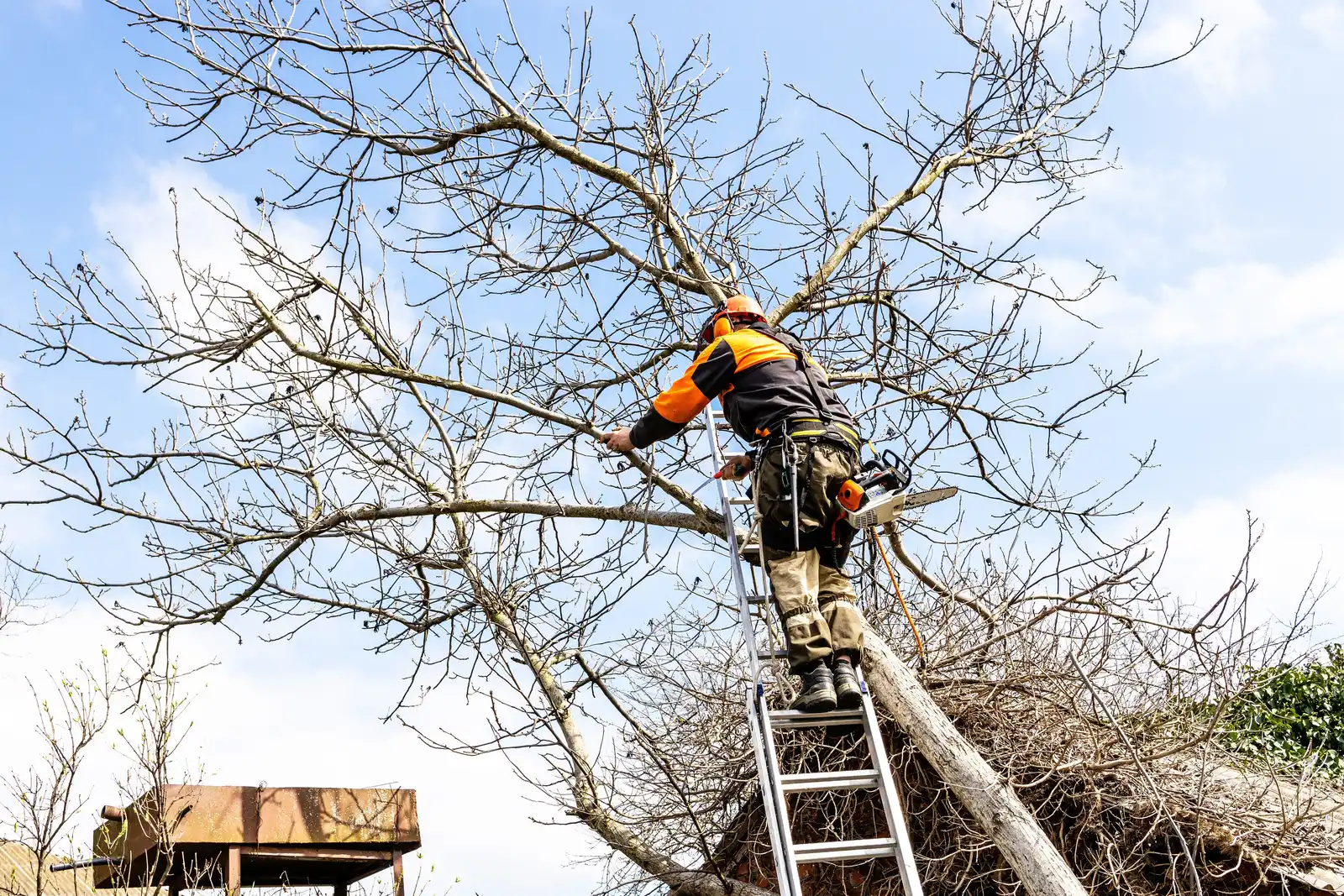
Utah concentrates most of its population, and most of its tree work, into a narrow strip of valley floor and bench between the Wasatch Range and the Great Salt Lake. That geography produces a specific kind of tree care business: dense urban and suburban canopy on irrigated ground, properties climbing onto steep benches where equipment access disappears, and a wind pattern coming off the canyons that can take out a neighborhood’s mature trees in a single night.
Utah is also unusually clear about where tree work sits in its licensing scheme. The state licenses construction trades through a division of the Department of Commerce, and its own administrative rule names tree removal on the list of activities that do not require a contractor license. That clarity is worth understanding precisely, because it settles one question and leaves several others open. This page covers what a Utah tree service program includes, what the licensing rule actually says, and where the state’s real exposures are.
What Tree Service Insurance Costs in Utah
Utah is an NCCI jurisdiction, so tree operations rate under class code 0106, and workers’ compensation is written in a competitive private market. Pricing tends to respond to the share of storm response work, whether crews are climbing bench and canyon properties or working from aerial units, and the operation’s claims history.
The ranges below reflect what most Utah tree service contractors typically pay:
- General Liability Insurance: $850–$2,500 per year for a typical Utah small operation. Work on the east benches of Salt Lake and Utah counties, where property values run high, tends toward the upper end.
- Workers’ Compensation Insurance: $7–$13 per $100 of payroll under class code 0106. A worked example: a crew with $200,000 of payroll typically pays $14,000–$26,000 annually.
- Commercial Auto Insurance: $1,900–$3,900 per truck per year. Wasatch Front congestion drives frequency, and winter canyon driving drives severity.
- Inland Marine (Equipment) Insurance: $400–$1,500 per year depending on schedule value, including rigging and climbing hardware carried on bench and canyon work.
- Pesticide & Pollution Liability: $400–$900 per year for operations doing injections, beetle and borer treatment, or herbicide under a state applicator license.
- Umbrella / Excess Liability: $500–$1,300 per year for a first excess layer, generally bought for municipal, university, ski resort or utility contracts.
Utah’s competitive market means a documented safety program and a clean loss run translate into pricing, provided the account is actually marketed rather than renewed in place. For the rating factors common to every state, see the national cost guide.
Workers’ Compensation in Utah
Utah Code § 34A-2-201 requires an employer to secure payment of workers’ compensation benefits for its employees, either by insuring with an insurer authorized under the Insurance Code to write the coverage in Utah, or by obtaining division approval to pay compensation directly as a self-insured employer.
The obligation follows employment. It does not wait for a headcount threshold, and it does not distinguish between full-time, part-time and seasonal help — which matters in a trade that staffs up for storm season and cleanup work.
Class Code 0106 in Utah
Utah is an NCCI state, so tree trimming, pruning and removal classify under 0106. The standard error is initial placement under 0042, landscape gardening, which prices lower and does not describe aerial work. Utah audits find it, and the correction arrives as retroactive premium.
What Utah Operators Should Watch
- Coverage is administered through the Labor Commission’s Division of Industrial Accidents
- Uninsured subcontractors are routinely treated as employees at audit
- Owner and officer elections must be documented with the carrier before a loss occurs
- Payroll reported by function rather than as one figure produces a more accurate rate, because a groundman is not a climber
Utah Names Tree Removal as License-Exempt — and That Is Narrower Than It Sounds
Most states leave tree service operators to work out licensing by inference. Utah does not, and the specific language is worth knowing.
Utah licenses construction trades through the Division of Occupational and Professional Licensing. The administrative rule setting out classifications and scopes of practice, R156-55a-301, includes a subsection listing activities that the division has determined do not significantly impact public health, safety and welfare and therefore do not require a contractor license. Tree stump or tree removal appears on that list at subsection (7)(c).
That is an explicit, affirmative carve-out. A Utah operation performing removals and stump grinding is not operating in a licensing gray area.
Three qualifications keep that from being the end of the matter:
- The exemption is about licensing, not liability. It says nothing about the workers’ compensation obligation under § 34A-2-201, about contractual insurance requirements, or about the standard of care owed on a job. An exempt operation is fully exposed to an ordinary negligence claim.
- Adjacent work is not exempt. The landscape classification, S330, reaches grading and preparation of land for horticultural treatment, the arrangement and planting of vegetation including trees, and defined installation work. A tree service that also installs beds, grades ground, or builds landscape structures is performing work inside a licensed classification, and the exemption for removal does not travel with it.
- Customers set their own bar. Municipalities, universities, resorts, HOAs and commercial property managers impose their own vendor requirements. Not needing a state license does not mean not needing a certificate, an additional insured endorsement, or a bond, and in practice the larger the contract the less the state exemption matters.
The useful way to hold it: Utah has removed one obstacle for tree services, and left every commercial obstacle exactly where it was.
General Liability
General liability answers bodily injury and property damage arising out of Utah tree operations — a limb through a roof, a rigging failure onto a vehicle, a neighbor injured at the edge of a drop zone.
Utah policies are typically occurrence-based with completed operations included, which keeps a failure that appears after the crew leaves inside coverage. Operations providing written tree health assessments or retention advice should look at professional liability, since that is advice rather than an operation.
Bench and foothill property in Salt Lake, Davis and Utah counties carries values that make a single property damage claim substantial. Limits should be sized against the structures beneath the work.
Commercial Auto
Utah fleets run pickups, chip trucks, aerial units and towed chippers and grinders through some of the most congested corridors in the Mountain West.
The gaps that recur:
- Chippers and grinders described as trailers at binding and never scheduled, leaving expensive machines uninsured while towed
- Hired and non-owned coverage missing where employees drive personal vehicles between job sites
- Aerial devices covered as vehicles with the boom in operation left unaddressed
Two Utah factors deserve attention. I-15 corridor congestion between Ogden and Provo produces accident frequency, and winter canyon driving — Big and Little Cottonwood, Parley’s, Provo Canyon — produces severity on grades where a loaded chip truck behaves very differently from a pickup.
Inland Marine / Equipment Floater
The floater covers portable property wherever the work happens, which in Utah frequently means a bench property where the truck parks well below the tree and everything is carried in.
That access pattern is the Utah-specific consideration. Equipment spends more of the day away from the vehicle and out of sight, and rigging and climbing hardware carried into steep ground is both valuable and easy to lose. Replacement cost settlement matters for life-safety equipment in particular, because a rope or harness retired on schedule should be replaced without a budget conversation.
Pesticide & Pollution Liability
The Utah Department of Agriculture and Food licenses commercial pesticide applicators. For Utah tree services the work concentrates in borer and bark beetle treatment, systemic injections for stressed urban trees, and herbicide for invasive control and rights-of-way.
General liability excludes pollution, so a drift or misapplication claim needs contractors’ pollution liability behind it. Utah’s exposure profile is shaped by irrigation: much of the Wasatch Front urban canopy is watered through pressurized secondary irrigation drawn from canals and creeks, which means an application that reaches a lawn can reach a shared water system far more directly than the same job would elsewhere.
Umbrella / Excess Liability
An umbrella adds limit above general liability, commercial auto and employer’s liability together. In Utah it is usually purchased because a contract requires it — municipal vegetation contracts, university and hospital campuses, ski resort work, and utility line clearance all commonly specify excess limits.
The first layer of excess is inexpensive relative to the primary program beneath it, which makes it the most efficient way to align an aging limit with the property a crew now works above.
Common Tree Service Risks in Utah
Canyon Downslope Windstorms
East wind events driven down the canyons onto the Wasatch Front can reach destructive speeds and flatten mature trees across whole neighborhoods in hours. The cleanup is concentrated, urgent, and performed on structurally failed trees near damaged buildings and downed lines.
Heavy Wet Spring Snow
Late-season snow falling on leafed-out canopy loads branches past their limits and splits codominant stems. The resulting removals are active structural failures rather than scheduled maintenance.
Steep Bench and Canyon Access
Foothill properties frequently rule out aerial lifts entirely, forcing climbing work on steep ground with constrained drop zones and difficult rigging — and making rescue of an injured climber materially harder.
Drought-Stressed Urban Canopy
Chronic water limitation across the Wasatch Front leaves mature planted trees under stress, accelerating decline and shifting the work mix toward removal and hazard assessment.
Bark Beetle and Borer Pressure
Conifer mortality in the mountains and borer pressure in valley hardwoods produce standing dead wood that is brittle, unpredictable under rigging, and unreliable to assess from the ground.
Rapid Growth and Construction Adjacency
Utah County and southern Salt Lake County are building quickly, which puts tree crews on active construction sites and near new structures — an environment with more parties, more equipment and more ways for a claim to involve someone other than the customer.
Why Utah Tree Service Owners Choose TreeGuard
We know what the licensing rule actually says. Being able to point at the subsection that exempts tree removal is useful, and so is knowing exactly how far that exemption reaches — which is not as far as most operators assume.
We separate licensing from coverage. Utah exempts removal from contractor licensing and still requires workers’ compensation for employees, and conflating the two is the most expensive mistake available here.
As an independent agency we represent 16+ A-rated carriers and take the account to the market. In a competitive state, a clean loss run is only worth what someone is willing to bid against it.
We write tree care exclusively. That is why climbing exposure on bench properties gets described accurately, why storm response is disclosed as storm response, and why a resort or university certificate goes out with the right endorsements attached.
Most Utah submissions are quoted within one to two business hours.
Major Utah Markets We Serve
We write tree service insurance across Utah, with concentration in:
- Salt Lake Valley: Salt Lake City, West Valley City, Sandy, Murray, West Jordan and the east benches — the largest urban canopy in the state and the center of downslope wind exposure.
- Utah County: Provo, Orem, Lehi, American Fork and Pleasant Grove — rapid residential growth, university work and construction-adjacent tree removal.
- Davis and Weber Counties: Ogden, Layton, Bountiful and Kaysville — established canopy on bench terrain with canyon wind exposure.
- Southern Utah: St. George, Washington and Cedar City — desert species, drought stress and a fast-growing retirement market.
- Wasatch Back: Park City, Heber and Midway — resort property, conifer work and defensible space demand.
- Cache Valley: Logan and Smithfield — agricultural windbreaks, university accounts and mature valley canopy.
Whether the operation is a single climber working the Avenues or a multi-crew outfit running municipal contracts along the Wasatch Front, we can place it in Utah.