
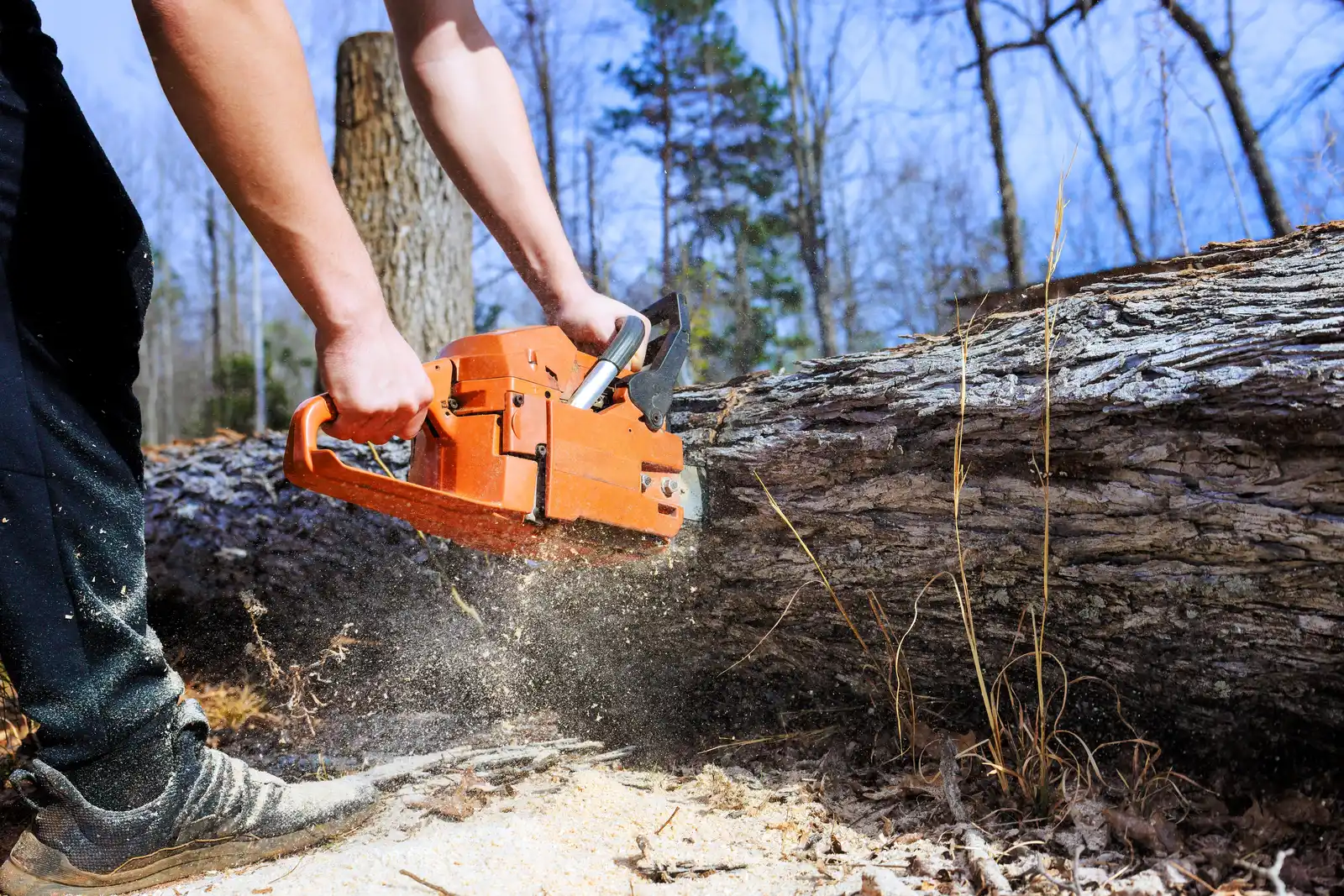
Mississippi is one of the most heavily forested states in the country, and almost two-thirds of it is timber. That shapes the tree care market in a way that is easy to misread: the abundance of trees does not create the work. The work comes from where trees meet people — the Jackson metro, the Gulf Coast strip from Bay St. Louis to Pascagoula, the DeSoto County suburbs pulling south out of Memphis, and the college and manufacturing towns strung along the Pine Belt and the Tennessee line.
Two structural facts then define the insurance picture, and both cut against the assumptions an operator brings from another state. Workers’ compensation is not owed until the fifth employee, which makes Mississippi one of the few states where a small crew is genuinely outside the mandate. And contractor licensing here attaches to what a job is and what it costs, not to the fact that it involves trees. This page covers both, what a Mississippi program costs, and what hurricanes and southern pine do to the work.
What Tree Service Insurance Costs in Mississippi
Mississippi is a competitive private market on every line, workers’ compensation included. Carriers price off filed loss costs with their own expense and profit factors, so presentation and loss history move the number.
The ranges below reflect what most Mississippi tree service contractors typically pay:
- General Liability Insurance: $850–$2,500 per year for a typical Mississippi small operation. Coastal work and the Madison and Rankin County suburbs north of Jackson run toward the upper half on property values.
- Workers’ Compensation: $7–$13 per $100 of payroll on class code 0106 — owed once the operation reaches five employees. A worked example: a crew with $200,000 of payroll typically pays $14,000–$26,000 annually.
- Commercial Auto Insurance: $1,900–$3,900 per truck per year, with long rural radius between jobs and heavy I-55 and I-10 mileage for coastal and Memphis-fringe operations.
- Inland Marine (Equipment) Insurance: $400–$1,500 per year, scaling with scheduled value and with how much gear stays staged after a storm.
- Pesticide & Pollution Liability: $400–$900 per year for operations treating under Bureau of Plant Industry certification.
- Umbrella / Excess Liability: $500–$1,300 per year for a first excess layer, commonly required by municipal, utility and casino or resort contracts on the Coast.
The number most likely to hurt a Mississippi operation is not on this list. It is the uninsured claim an under-five crew absorbs directly. For the rating factors that apply in every state, see the national cost guide.
Workers’ Compensation in Mississippi: The Threshold Is Five
Most states attach the compensation obligation to the first employee. Mississippi attaches it to the fifth, and the difference is large enough to reorganize how a small operation thinks about risk.
Miss. Code § 71-3-5 lists the employers subject to the chapter, reaching every person, firm and private corporation having in service five or more workmen or operatives regularly in the same business. The section excludes nonprofit charitable, fraternal, cultural and religious organizations, and it excludes domestic servants, farmers and farm labor — though that agricultural exclusion expressly does not extend to the processing of agricultural products carried on commercially.
Three points matter for a tree service.
Regularly Employed Is the Test, Not Full-Time
The statute counts workmen or operatives employed regularly in the same business, so part-time and seasonal crew working regularly count. An operation running four year-round that adds a fifth through storm season has a question to answer about that season.
Owner Elections Change the Count
An employer may elect in writing, by proper action of its governing authority, to exempt a sole proprietor, a partner, or an employee owning fifteen percent or more of the corporation’s stock — with that person’s written agreement — and anyone so exempted is excluded from the total counted toward the threshold. That is a real planning lever, and also a way an operation can believe it is under five when the arithmetic says otherwise.
Being Outside the Mandate Is Not the Same as Being Safe
A four-person Mississippi tree service is legally permitted to go without coverage, and nothing about that reduces the exposure. Tree work carries one of the higher injury severities in commercial insurance, and an uninsured employer sits outside the compensation system entirely — which means outside the exclusive remedy that ordinarily stops an injured employee from suing. The choice is not between paying a premium and paying nothing; it is between a premium and an uncapped liability.
The commercial consequence is just as direct. Municipal, utility, casino and property management clients require a certificate regardless of headcount, and a general contractor will treat an uninsured sub’s payroll as its own at audit. Declining coverage closes off the part of the market that pays best.
Claims are administered by carriers; the Mississippi Workers’ Compensation Commission handles disputes.
Mississippi Licensing: By Scope and Size, Not by Trade
The Mississippi State Board of Contractors licenses contractors by classification and project threshold. There is no arborist license and no tree care trade license — and the absence is worth stating precisely, because guidance circulating online claims otherwise.
We reviewed the Board’s published classification list in full. It contains no occurrence of the words arborist or tree surgery anywhere. Claims that Mississippi issues a tree surgery license are not supported by the Board’s own classification schedule.
What the schedule does contain are three classifications a tree service can land in, depending on what the job actually is:
- Right of Way Clearing — covering the clearing, cutting, transportation and removal of logs, trees and other vegetation from roads, highways, power lines, communication lines and other utilities. Utility line clearance sits here.
- Clearing, Grubbing and Snagging — for removing and disposing of all trees, brush, shrubs, logs, windfalls, stumps, roots and debris in preparation for excavation of a construction site. Lot clearing and site prep sit here.
- Landscaping, Grading and Beautification — a tested classification covering landscaping, hardscaping, planting, mowing and trimming, excluding irrigation. The Board’s entry directs applicants to the Bureau of Plant Industry for additional requirements.
The Threshold Does the Work
An ordinary residential tree removal fits none of those three descriptions. What governs it instead is project size: commercial work over $50,000 and residential remodeling or additions over $10,000 fall within the Board’s licensing requirement, and a scope exceeding $50,000 that is not defined under any other classification falls into Limited Specialty Services — for which the Board requires no examination or credential.
The practical consequence is that the licensing question here is answered by reading the contract, not by describing the trade. A crew that spends the year on residential removals may never need a Board license; the same crew taking one large commercial storm contract may. Worth resolving before signing.
General Liability
General liability answers bodily injury and property damage arising out of Mississippi tree operations, occurrence-based with completed operations included.
Limit selection splits along the state’s two high-value corridors. The Gulf Coast carries casino, resort and condominium property with vendor agreements that specify $2 million per occurrence as a matter of course. The Jackson northern suburbs — Madison, Ridgeland, Brandon — carry the state’s most expensive residential stock under mature oak and pine close to houses.
Operations providing written condition reports or retention advice should carry professional liability separately, since a general liability form answers the work rather than the opinion.
Commercial Auto
Mississippi fleets cover distance, and the roads are fast.
Three gaps account for most of what we correct: towed chippers left unscheduled because nobody thinks of a chipper as a vehicle, hired and non-owned coverage missing where crew use their own trucks, and bucket trucks carrying road coverage while boom operation sits outside the policy.
The Mississippi factor is radius drift in storm season. An operation that files a fifty-mile radius then works a coastal debris field for three weeks has changed its own rating basis mid-term, and saying so beforehand is the difference between a covered claim and an argument.
Inland Marine / Equipment Floater
The floater follows portable equipment to job sites, in transit and into overnight storage.
Mississippi adds humidity and staging. Chains, bar rails, bearings and fittings corrode faster in Gulf air, and corrosion is generally excluded as wear rather than covered as damage. After a storm, equipment does not come home each night — it sits at a staging lot with other contractors’ machines. Read the unattended-property conditions before that happens, and write the schedule on replacement cost.
Pesticide & Pollution Liability
The Bureau of Plant Industry within the Mississippi Department of Agriculture and Commerce administers pesticide applicator certification. For a tree service the work is borer and beetle treatment, systemic injection into stressed specimen trees, and herbicide along fence lines and rights-of-way.
General liability excludes pollution, so drift, overapplication and off-target injury need contractors’ pollution liability. Mississippi concentrates that exposure through agriculture and water together: the Delta is intensively farmed and intensively irrigated, the coastal counties drain to the Mississippi Sound, and an application that reaches a neighboring row crop or an oyster water is a claim against somebody’s livelihood rather than an ornamental bed.
Umbrella / Excess Liability
An umbrella adds limit above general liability, commercial auto and employer’s liability at once.
Mississippi triggers are utility line clearance contracts, municipal and county work, casino and resort vendor agreements on the Coast, and university accounts in Oxford, Starkville and Hattiesburg. A first layer costs a fraction of the underlying program.
A Timber State Where the Trees Are Not the Market
The instinct in a state two-thirds covered in forest is to assume tree work is everywhere. It is not, and understanding the distribution is how a Mississippi submission gets built properly.
Most Mississippi timber is a crop — loblolly and slash pine on managed acreage, cut on rotation by logging contractors under logging classifications, with different equipment and a different insurance program entirely. None of that is arboriculture, and an operation that drifts into lot clearing on the strength of owning a mulcher has changed what it is.
Paid tree care lives where trees have targets, and in Mississippi that means four bands: the Jackson metro and its northern suburbs, with mature water oak and pine over the state’s most valuable residential stock; the Gulf Coast, where salt and dense seasonal occupancy meet casino and condominium property; DeSoto County, functioning as suburban Memphis; and the college and manufacturing towns — Oxford, Starkville, Hattiesburg, Tupelo, Meridian — each an island of maintained canopy in working countryside.
Three consequences follow for an operation and its insurer.
The species mix is hardwood where the money is and pine where it is not. Urban canopy runs to water oak and willow oak, fast and brittle and short-lived for their size; pine dominates the countryside. The two fail differently and demand different rigging assumptions on the same day.
Storm response is not a sideline. Between Gulf tropical systems and a tornado season running in both spring and late fall, a large share of Mississippi revenue arrives in bursts. Payroll swings hard, which drives the audit rather than the deposit.
Water oak decline is a standing book of work. Planted heavily in mid-century subdivisions, these trees are reaching the end of a short service life together — removal demand concentrated by neighborhood rather than scattered by chance.
Common Tree Service Risks in Mississippi
Hurricanes and Tropical Systems
Direct landfall risk on the Coast and inland wind and saturated ground through the Pine Belt. One system produces a year of removals in a week, on trees that have already failed.
Tornadoes
Mississippi sits in Dixie Alley, with a spring and a secondary late-autumn season. Post-tornado cleanup is emergency work on debris fields with unstable trees and damaged utilities.
Southern Pine Failure
Loblolly and slash pine snap rather than tear, offer unpredictable hinge wood, and drop large tops with little warning — especially after beetle activity or storm loading.
Water Oak Decline
The dominant urban shade tree across much of the state is fast, brittle and short-lived. Whole subdivisions reach end of life together, concentrating hazardous removal work.
Saturated Ground and Delta Soils
Heavy rainfall, a high water table and soft alluvial soils let root plates release under loads that would hold elsewhere.
Why Mississippi Tree Service Owners Choose TreeGuard
We put the five-employee question first, and we answer it honestly in both directions. An operation genuinely under the threshold should understand what it is retaining, not simply be sold a policy. An operation near the threshold should know that a storm-season hire can cross it.
We check the licensing question against the contract rather than the trade. Whether a Mississippi job needs a Board license turns on classification and dollar threshold, and that is a question best resolved before signing.
As an independent agency we represent 16+ A-rated carriers and shop the whole program. Mississippi is competitive on every line, and a submission that explains the storm-driven share of the book earns a better number than one that presents an average year.
We work in tree care only. That is why class code 0106 is right at the outset, why the boom question gets asked about the aerial device, and why pine is discussed as the failure mode it actually is.
Most Mississippi submissions are quoted within one to two business hours.
Major Mississippi Markets We Serve
We write tree service insurance statewide, with concentration in:
- Jackson Metro: Jackson, Madison, Ridgeland, Brandon and Clinton — the state’s largest market, with mature urban canopy, the most valuable residential stock in Mississippi, and substantial commercial and state government work.
- The Gulf Coast: Gulfport, Biloxi, Pascagoula and Bay St. Louis — casino and condominium accounts, salt exposure and the state’s highest storm-driven volume.
- DeSoto County: Southaven, Olive Branch and Horn Lake — suburban Memphis growth, newer subdivisions meeting remnant hardwood.
- The Pine Belt: Hattiesburg and Laurel — university and hospital accounts in a working pine landscape.
- Northeast Mississippi: Tupelo, Oxford and Starkville — campus and manufacturing accounts.
- The Delta and East: Greenville, Greenwood and Meridian — agricultural edge work and long rural radius.
Whether the operation is one truck working the Delta or a multi-crew company across the Jackson metro, we can place it.